


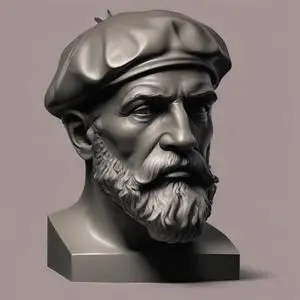
A French sculptor and illustrator famous for creating iconic, emotionally charged figures that capture the human experience, including the iconic symbol of intellectualism, The Thinker.
Auguste Rodin, widely regarded as the founder of modern sculpture, stunned the art world with his innovative and provocative works that continue to inspire and influence artists to this day. His iconic masterpieces, such as The Thinker, The Kiss, and The Gates of Hell, are testaments to his genius and rebellious spirit.
Rodin was born on November 12, 1840, in Paris, France, to a humble family. His early interest in art was encouraged by his father, a policeman, who recognized his son's talent and enrolled him in the Special School of Drawing and Mathematics. Rodin's artistic journey began with traditional training in sculpture, but he soon deviated from conventional techniques, embracing a more experimental and expressive approach.
Rodin's rejection of traditional figurative sculpture was a deliberate choice, driven by his passion for capturing the raw, unbridled essence of the human form. His sculptures were not mere decorations, but rather a celebration of individuality, physicality, and emotion. This departure from tradition sparked controversy, but Rodin remained unwavering, convinced that his art was a reflection of the world's complexity and turbulence.
Rodin's trailblazing approach to sculpture has inspired generations of artists, from Antoine Bourdelle to Henry Moore. His emphasis on naturalism, texture, and emotion paved the way for modern and contemporary sculpture. By the time of his death in 1917, Rodin was an international celebrity, with his works sought after by museums and private collectors worldwide.
Rodin's romantic relationships, particularly with Camille Claudel, his student and collaborator, were often tumultuous and passionate. His marriage to Rose Beuret, his lifelong companion, occurred just a year before his passing. Rodin's personal life was marked by both joy and turmoil, reflecting the intensity and drama that fueled his art.
Rodin's artistic philosophy was rooted in his conviction that sculpture should evoke emotions, stir the senses, and challenge conventions. He saw his art as a means to express the human experience, with all its complexities and contradictions. By exploring the boundaries between beauty and ugliness, Rodin expanded the potential of sculpture, redefining its role in the art world.
Auguste Rodin's revolutionary sculptures continue to captivate audiences, inspiring new generations of artists, architects, and designers. His unwavering dedication to his artistic vision has left an indelible mark on the world of art, ensuring his place as one of the most influential sculptors of all time.
Born in 1864
French illustrator and sculptor renowned for her pioneering work in Rodin's studio and her own expressive, emotional sculptures that explored the human form. Her tragic life and tumultuous relationship with Rodin have become legendary.
Born in 1839
A post-Impressionist pioneer, he's famous for his still-life compositions and landscapes that laid the groundwork for Cubism, influencing 20th-century art.
Born in 1869
A pioneering artist who revolutionized modern art with bold, expressive, and colorful works that blurred the lines between painting and sculpture, creating a new language of form and color.
Born in 1881
A pioneering artist who transformed modern art with pioneering Cubist works, creating a new visual language that continues to inspire and influence art, design, and culture.
Born in 1882
A pioneer of Cubism, creating fragmented forms and multiple perspectives in art, revolutionizing modern art movements.
Born in 1884
An Italian artist famous for elongated, emotive portraits and nudes that blended primitivism with cubism, capturing the essence of his subjects with expressive simplicity.
Born in 1890
Austrian soldier and painter who captured the intensity of human emotion through bold, expressive portraits and landscapes, often exploring themes of death, sexuality, and the human condition.
Born in 1561
A 16th-17th century Renaissance figure who pioneered the scientific method and empiricism, and served as a prominent government official.
