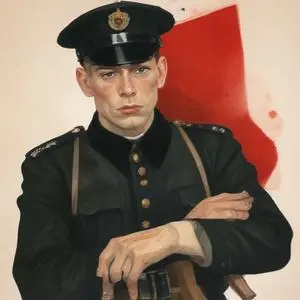
Egon Schiele: The Tortured Soul of Austrian Expressionism
A Visionary of Intensity and Raw Sexuality
Egon Schiele was an Austrian Expressionist painter renowned for his intense and provocative works, which continue to unsettle and fascinate art lovers to this day. His artistic style, characterized by twisted body shapes and expressive lines, has left an indelible mark on the art world, earning him a reputation as a pioneer of Expressionism.
Early Life and Family Influences
Born on June 12, 1890, in Tulln, Lower Austria, Schiele was the son of Adolf Schiele, a station master, and Marie Soukup, a Czech-German mother. His family's mixed cultural heritage would later influence his artistic perspective. As a child, Schiele was fascinated by trains, which his father, fearing it would distract him from his studies, would often destroy his sketchbooks. This early suppression of his creative urge may have contributed to the intense emotional depth that would later characterize his artwork.
Formative Years and Gustav Klimt's Mentorship
At 11, Schiele moved to Krems and later to Klosterneuburg to attend secondary school. He was a shy and reserved student who struggled academically, except in athletics and drawing. It was during this period that he developed an incestuous fascination with his younger sister, Gertrude, which would later manifest in his art. In 1906, Schiele's father died, and his uncle, Leopold Czihaczek, took him under his wing. Czihaczek recognized Schiele's talent and encouraged him to apply to the Academy of Fine Arts in Vienna, where he would meet his mentor,
Gustav Klimt.
Rise to Prominence and Artistic Innovations
Under Klimt's guidance, Schiele's unique style began to take shape. He became known for his bold, expressive lines, and his daring depiction of the human form, often bordering on the erotic. His self-portraits, including nude renderings, showcased his technical skill and emotional depth. Schiele's art was not only a reflection of his own psyche but also a commentary on the societal norms of his time.
Major Works and Career Highlights
- Self-Portrait with Physalis (1912): A quintessential example of Schiele's unique style, showcasing his bold lines and expressive use of color.
- The Hermits (1912): A powerful depiction of two emaciated figures, symbolizing Schiele's own feelings of isolation and despair.
- Death and the Maiden (1915): A haunting representation of the inevitability of death, featuring a skeletal figure embracing a young woman.
Personal Struggles and Tragic Demise
Schiele's life was marked by personal struggles, including his tumultuous relationships and his experiences during World War I. In 1918, he contracted the Spanish flu, which ultimately led to his tragic death at the age of 28. His wife, Edith, who was six months pregnant, succumbed to the same illness just three days before his passing.
Legacy and Impact on Modern Art
Egon Schiele's artistic innovations have inspired generations of artists, from Expressionists like
Oskar Kokoschka to contemporary artists like
Francis Bacon and
Lucian Freud. His unflinching portrayal of the human condition, with all its attendant anxieties and desires, continues to captivate audiences today, cementing his status as a visionary of Austrian Expressionism.
Quotes and Memorable Sayings
- "Art cannot be modern. Art is primordially eternal."
- "I do not paint what I see, but what I saw."
Trivia and Fun Facts
- Schiele was known to have a fascination with trains, which would often feature in his artwork.
- He was a prolific artist, producing over 300 paintings and numerous drawings during his short lifetime.
Historical Context and Legacy
Egon Schiele's artistic contributions continue to resonate with our contemporary world, where the boundaries between art and life are increasingly blurred. As a pioneer of Expressionism, his work serves as a testament to the power of art to express the deepest, most primal aspects of the human experience.
FAQ
What was Egon Schieles artistic style, and how did it evolve?
Egon Schieles artistic style was characterized by expressive, distorted forms and vivid, often clashing colors, which evolved over time to incorporate more symbolic and emotive elements.
How did Egon Schieles experiences in World War I influence his art?
Egon Schieles experiences in World War I had a profound impact on his art, leading to a more somber, introspective tone and the creation of works that reflected his own emotional turmoil.
What role did Egon Schiele play in the development of Expressionism?
Egon Schiele played a significant role in the development of Expressionism, contributing to the movements emphasis on intense emotional expression, bold colors, and distorted forms.
How did Egon Schieles art reflect his personal life and relationships?
Egon Schieles art often reflected his personal life and relationships, particularly his tumultuous romantic relationships, which are depicted in numerous drawings and paintings.
What legacy did Egon Schiele leave in the art world?
Egon Schiele left a lasting legacy in the art world, remembered for his bold, expressive style and his significant contributions to the development of Expressionism.