


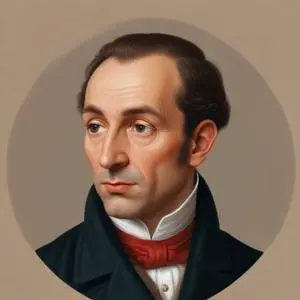
Developed rigorous mathematical theories and introduced concepts like convergence and continuity, revolutionizing calculus and paving the way for modern mathematics.
Augustin-Louis Cauchy, a French mathematician, engineer, and physicist, is renowned for rigorously stating and proving key theorems in calculus, thereby laying the foundations of real analysis. His groundbreaking work in complex analysis and permutation groups in abstract algebra has had a profound impact on the development of modern mathematics.
Born on August 21, 1789, in Paris, France, Cauchy was the son of Louis François Cauchy, a high-ranking official in the Parisian police, and Marie-Madeleine Desestre. Due to the French Revolution, the family escaped to Arcueil, where Cauchy received his early education.
Cauchy's contributions have had a profound impact on modern mathematics, with Hans Freudenthal stating, "More concepts and theorems have been named after Cauchy than any other mathematician." His work has influenced numerous mathematicians, including Karl Weierstrass, Bernhard Riemann, and Sophus Lie.
Cauchy married Aloise de Bure in 1818, and they had two daughters, Marie-Françoise Alicia and Marie-Mathilde. He was a prolific writer, publishing approximately 800 research articles and five comprehensive textbooks on various topics in mathematics and mathematical physics.
Cauchy was elected to the French Academy of Sciences in 1816 and was awarded the Grand Prix de Mathématiques in 1815 and 1824. He was also appointed as a professor at the École Polytechnique and later became a member of the Royal Swedish Academy of Sciences.
Cauchy's quote, "Theorem, Proof, Theorem, Proof, and so on, is the very essence of mathematics," highlights his emphasis on rigorous mathematical proofs.
Cauchy's work emerged during a time of significant mathematical and scientific progress. His contributions, alongside those of other pioneers like Pierre-Simon Laplace and Joseph-Louis Lagrange, have shaped the course of modern mathematics and continue to influence mathematical research today.
In conclusion, Augustin-Louis Cauchy's profound impact on mathematics, physics, and engineering has cemented his place as one of the most influential mathematicians of all time. His rigorous approach to mathematics has paved the way for groundbreaking discoveries, and his legacy continues to inspire mathematicians and scientists worldwide.
Born in 1749
Developed nebular hypothesis of the origin of the solar system and formulated Laplace's equation, a fundamental concept in mathematics and physics. He's considered the founder of celestial mechanics.
Born in 1736
Developed calculus, number theory, and celestial mechanics, making significant contributions to the fields of mathematics and astronomy.
Born in 1752
Developed the theory of elliptic integrals, and his work on number theory laid the foundation for modern cryptography.
Born in 1777
A pioneer in mathematics and physics, he made major contributions to number theory, algebra, and electromagnetism, shaping our understanding of the natural world.
Born in 1802
A pioneer in mathematics, he made groundbreaking contributions to the field of algebra, particularly in the development of group theory and the proof of the impossibility of solving quintic equations using radicals.
