


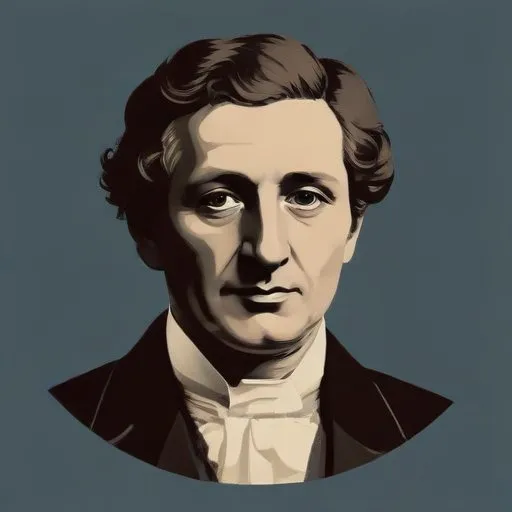
Developed the De Morgan's laws, which are fundamental principles in logic and set theory, and made significant contributions to the development of modern mathematics.
Augustus De Morgan (1806-1871) is renowned for formulating De Morgan's laws, a fundamental concept in logic, set theory, and computer science. He is also credited with coining the term "mathematical induction" and formalizing the principles of induction, which have far-reaching implications in various fields.
De Morgan was born in Madurai, India, to Lieutenant-Colonel John De Morgan and Elizabeth De Morgan (née Dodson). His father was a British citizen, and his mother was from a family of mathematicians; her grandfather, James Dodson, had computed a table of antilogarithms (inverse logarithms). Unfortunately, De Morgan lost sight in one eye within a few months of his birth.
When De Morgan was just seven months old, his family moved to England. His father's untimely death when De Morgan was ten years old left a significant impact on his life. Despite this, his mathematical talents went unnoticed until he was fourteen, when a family friend discovered him creating an intricate drawing of a figure from one of Euclid's works using a ruler and compasses.
De Morgan received his secondary education from Mr. Parsons, a fellow of Oriel College, Oxford, who favored classics over mathematics. However, this did not deter De Morgan's passion for mathematics. In 1823, at the age of sixteen, he enrolled in Trinity College, Cambridge, where he met lifelong friends and influential mathematicians George Peacock and William Whewell.
De Morgan's interests in the renovation of algebra and logic were largely influenced by his mentors Peacock and Whewell. He went on to make significant contributions to these fields, including:
De Morgan's work has had a profound impact on various fields, including:
De Morgan's personal life was marked by significant events, including:
Augustus De Morgan's contributions to logic, mathematics, and probability have left an indelible mark on modern society. His work has inspired generations of mathematicians, logicians, and computer scientists, and continues to shape the course of various fields. As a testament to his legacy, De Morgan's laws remain a fundamental concept in modern mathematics and computer science.
Born in 1815
Developed Boolean logic, a system of algebraic notation for logical operations that laid the foundation for modern computer science and electronic communication.
Born in 1821
Developed the theory of matrices and introduced the concept of groups, revolutionizing abstract algebra and paving the way for modern mathematics.
Born in 1802
A pioneer in mathematics, he made groundbreaking contributions to the field of algebra, particularly in the development of group theory and the proof of the impossibility of solving quintic equations using radicals.
Born in 1811
Developed the theory of groups, which revolutionized algebra and paved the way for modern number theory, and his work laid the foundation for many mathematical and scientific advancements.
Born in 1845
Developed set theory, introducing infinite sets and cardinal numbers, revolutionizing mathematics and philosophy.
Born in 1831
Developed a rigorous definition of real numbers and introduced the concept of Dedekind cuts, revolutionizing mathematics and laying the foundation for modern analysis. His work also explored the nature of infinity and the foundations of mathematics.
Born in 1858
Developed a formal system of mathematical logic and notation, and created a new approach to mathematical rigor, influencing the development of modern mathematics.
