


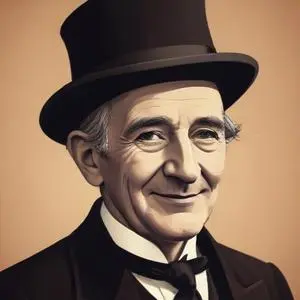
Developed the theory of matrices and introduced the concept of groups, revolutionizing abstract algebra and paving the way for modern mathematics.
Arthur Cayley was a British mathematician who revolutionized the field of algebra, laying the foundations for modern algebraic thinking. He is best known for his work on the Cayley-Hamilton theorem, which states that every square matrix is a root of its own characteristic polynomial.
Born on August 16, 1821, in Richmond, London, Cayley spent his early years in Saint Petersburg, Russia, where his father worked as a merchant. At the age of 8, his family returned to London, and he attended a private school before entering King's College School at 14.
Recognizing his exceptional math skills, Cayley's schoolmaster advised his father to send him to the University of Cambridge, where he began his residence at Trinity College in 1838. He excelled in languages such as Greek, French, German, and Italian, in addition to mathematics.
The Cayley-Hamilton theorem, which he postulated and verified for matrices of order 2 and 3, is one of his most significant contributions to algebra.
He was the first to define the concept of an abstract group, a set with a binary operation satisfying certain laws, which laid the foundation for modern group theory.
Cayley tables, Cayley graphs, and Cayley's theorem are named in his honor, recognizing his impact on group theory and combinatorics.
Cayley was a professor at Trinity College, Cambridge, for 35 years, where he worked tirelessly to develop and promote pure mathematics in Britain. His paper "On the Theory of Linear Transformations" (1846) is considered a landmark in the development of linear algebra.
Arthur Cayley's work had a profound impact on modern mathematics, influencing prominent mathematicians such as William Rowan Hamilton, Felix Klein, and Emmy Noether. His abstract approach to group theory paved the way for subsequent developments in abstract algebra and geometry.
Today, Cayley's contributions are recognized in various fields, including computer science, physics, and computer graphics, where his work on matrices and group theory has found practical applications.
Cayley was a humble and gentle soul, known for his simplicity and kindness. He was a fellow of the Royal Society and received the Copley Medal in 1882 for his outstanding contributions to mathematics.
Arthur Cayley passed away on January 26, 1895, leaving behind a rich legacy in the world of mathematics. His work continues to inspire and influence mathematicians and scientists to this day.
Born in 1707
Pioneering mathematician and physicist who made immense contributions to fields like calculus, number theory, and optics, shaping the course of modern mathematics and physics.
Born in 1777
A pioneer in mathematics and physics, he made major contributions to number theory, algebra, and electromagnetism, shaping our understanding of the natural world.
Born in 1789
Developed rigorous mathematical theories and introduced concepts like convergence and continuity, revolutionizing calculus and paving the way for modern mathematics.
Born in 1826
A pioneering mathematician who developed the theory of higher dimensions and laid the foundations for modern physics, particularly in the understanding of space and time.
Born in 1849
A pioneer in geometry and group theory, known for developing the Erlangen program, which unified various geometries under a single framework. His work laid foundations for modern algebraic geometry and topology.
Born in 1862
A renowned mathematician and academic who developed infinite-dimensional vector spaces and laid the foundation for quantum mechanics and relativity. He's also famous for his 23 unsolved math problems that shaped 20th-century mathematics.
Born in 1882
A pioneering mathematician and physicist who revolutionized abstract algebra and made groundbreaking contributions to modern physics, particularly in the development of Einstein's theory of general relativity.
73 Years Old
Proved Fermat's Last Theorem, a problem that went unsolved for over 350 years, and made significant contributions to number theory. His work has far-reaching implications for mathematics and cryptography.
