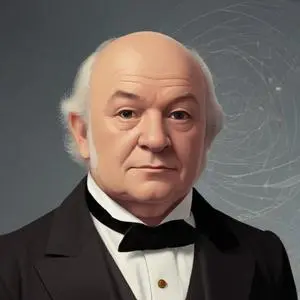
William Rowan Hamilton: The Mathematical Maverick Who Revolutionized Physics
Breaking Ground in Geometrical Optics and Quaternions
William Rowan Hamilton, an Irish mathematician, astronomer, and physicist, is renowned for his groundbreaking contributions to the fields of geometrical optics, Fourier analysis, and quaternions. His work laid the foundation for modern linear algebra, making him one of the most influential mathematicians of the 19th century.
Early Life and Education
Born on August 4, 1805, in Dublin, Ireland, Hamilton was the fourth of nine children to Sarah Hutton and Archibald Hamilton. His father, a solicitor, recognized his son's exceptional talent at an early age and encouraged his education. Hamilton's uncle, James Hamilton, a Trinity College graduate, took him under his wing and provided him with a solid foundation in languages, including Hebrew, Persian, Arabic, and many others. This emphasis on languages was likely due to his father's desire for Hamilton to work for the British East India Company.
Academic Career and Contributions
Hamilton's academic career began at Trinity College Dublin, where he was appointed as the Andrews Professor of Astronomy in 1827. He went on to become the Royal Astronomer of Ireland and the director of Dunsink Observatory, a position he held until his death in 1865. During his tenure, Hamilton made significant contributions to various fields, including:
- Geometrical Optics: Hamilton's work on the theory of systems of rays and his development of the method of characteristic functions revolutionized the field.
- Fourier Analysis: He applied Fourier analysis to the study of periodic functions, paving the way for future mathematicians.
- Quaternions: Hamilton's discovery of quaternions, a mathematical concept that extends complex numbers to four dimensions, has had a profound impact on modern theoretical physics, particularly in electromagnetism and quantum mechanics.
HAMILTONian Mechanics: A Paradigm Shift
Hamilton's reformulation of Newtonian mechanics, known as Hamiltonian mechanics, is perhaps his most significant contribution to physics. This approach, which uses energy rather than force to describe systems, has become a cornerstone of modern theoretical physics. The Hamiltonian function, a concept he introduced, is now central to both electromagnetism and quantum mechanics.
Influence on Modern Society
Hamilton's work has had a profound impact on modern society, influencing various fields, including:
- Theoretical Physics: His work on quaternions and Hamiltonian mechanics has shaped our understanding of the universe.
- Engineering: His contributions to geometrical optics have led to advancements in fields like optics, computer graphics, and robotics.
- Computing: Quaternions are used in computer graphics, game development, and robotics to perform 3D rotations.
Personal Milestones and Key Life Events
Hamilton's life was marked by several significant events, including:
- 1827: Appointed as the Andrews Professor of Astronomy at Trinity College Dublin.
- 1834: Elected as a Fellow of the Royal Society (FRS).
- 1837: Became the Royal Astronomer of Ireland.
- 1865: Passed away on September 2, at the age of 60, leaving behind a legacy that continues to shape modern science.
Legacy and Honors
Hamilton's contributions have been recognized and honored through various awards and commemorations, including:
- The Royal Medal (1835)
- The Cunningham Medal (1836)
- The Hamilton crater on the Moon is named in his honor.
- The Royal Irish Academy established the Hamilton Prize in his honor.
William Rowan Hamilton's work has left an indelible mark on the fields of mathematics and physics, shaping our understanding of the universe and paving the way for future generations of scientists and mathematicians.
FAQ
What was William Rowan Hamiltons most notable scientific contribution?
William Rowan Hamilton was an Irish physicist, astronomer, and mathematician who made significant contributions to the development of quantum mechanics, particularly in the area of quaternions.
How did William Rowan Hamiltons work impact the field of mathematics?
William Rowan Hamiltons work on quaternions and vector analysis laid the foundation for modern mathematics and had a profound impact on the development of physics and engineering.
What was William Rowan Hamiltons approach to scientific research?
William Rowan Hamilton was known for his meticulous approach to scientific research, which involved thorough experimentation and rigorous mathematical analysis.
What inspired William Rowan Hamiltons scientific curiosity?
William Rowan Hamilton was inspired by his love of nature and his desire to understand the underlying laws of the universe, which drove his scientific inquiry and discovery.
How is William Rowan Hamilton remembered in scientific history?
William Rowan Hamilton is remembered as a pioneering scientist who made significant contributions to our understanding of the natural world and whose work continues to influence scientific discovery today.