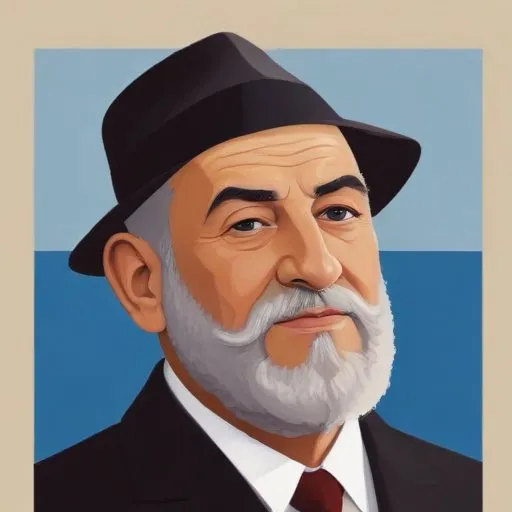
Avraham Stern: The Enigmatic Leader of Lehi
Alias Yair: A Militant Zionist
Avraham Stern, alias Yair, was a prominent figure in the Jewish paramilitary organization Irgun, and later, the founder of the breakaway group Lehi, dubbed the Stern Gang by the British authorities and the mainstream Yishuv Jewish establishment. He is remembered for his radical approach to Zionist militancy, which often put him at odds with the established Jewish leadership.
Early Life and Education
Born on December 23, 1907, in Suwalki, Poland, then part of the Russian Empire, Stern's early life was marked by turmoil and displacement. During World War I, his mother fled with him and his brother David to Russia, where they took refuge with her sister. After being separated from his mother, the 13-year-old Stern supported himself by carrying river water in Siberia. He eventually joined an uncle in St. Petersburg before making his way back to Poland on foot.
In 1925, at the age of 18, Stern emigrated to Mandatory Palestine, where he enrolled in the Hebrew University on Mount Scopus in Jerusalem. He specialized in Classical languages and literature, focusing on Greek and Latin. During his time at the university, Stern became increasingly involved in Zionist politics, founding a student organization called Hulda, dedicated to the revival of the Hebrew nation in a new state.
Rise to Prominence
Stern's first foray into military activism came during the 1929 riots in Palestine, when Jewish communities came under attack by local Arabs. He served with the Haganah, performing guard duty on a synagogue rooftop in Jerusalem's Old City. However, his commander and friend, Avraham Tehomi, quit the Haganah due to its association with the local labor movement and union. Tehomi founded the Irgun, an independent army with a more active and less defensive military stance. Stern followed Tehomi's lead, joining the Irgun and eventually rising through its ranks.
Founding of Lehi
In September 1940, Stern broke away from the Irgun, citing disagreements over strategy and ideology. He founded Lehi, a militant Zionist group that would come to be known for its radical tactics and ideologically driven agenda. Lehi's members referred to themselves as "terrorists" and admitted to carrying out terrorist attacks.
Controversial Legacy
Stern's legacy is marred by controversy, particularly due to Lehi's attempts to form an alliance with Nazi Germany against the British during World War II. This decision has been widely criticized, and its implications continue to be debated among historians and scholars. On February 12, 1942, Stern was captured and killed by British colonial police.
Philosophical Contributions and Beliefs
Stern's beliefs were shaped by his deep commitment to Zionist ideology. He saw the creation of a Jewish state as the ultimate goal, and was willing to employ unconventional means to achieve it. His ideology was founded on the principles of Jewish empowerment, self-defense, and the rejection of British authority in Palestine.
Personal Milestones and Key Life Events
- 1925: Emigrated to Mandatory Palestine at the age of 18
- 1929: Participated in the Haganah during the Palestinian riots
- 1940: Founded Lehi, a breakaway militant Zionist group
- 1942: Captured and killed by British colonial police
Influence on Modern Society
Stern's legacy continues to be felt in modern Israeli politics, with many seeing him as a pioneering figure in the fight for Jewish independence. However, his controversial methods and ideology have also been widely criticized, and his legacy remains a subject of debate among historians and scholars.
Historical Context and Legacy
Avraham Stern's life and legacy are inextricably linked to the tumultuous period of Zionist militancy during the British Mandate era. His radical approach to Zionist politics continues to inspire and divide, serving as a testament to the complexities and contradictions of the Zionist movement. As a historical figure, Stern remains a fascinating and enigmatic character, whose beliefs and actions continue to shape our understanding of the Jewish struggle for independence.
FAQ
What was Avraham Sterns role in the Israeli independence movement?
Avraham Stern was a key figure in the Israeli independence movement, leading the Lehi organization, also known as the Stern Gang, in its fight against British rule in Palestine.
What were Avraham Sterns views on Zionism?
Avraham Stern was a staunch Zionist who believed in the establishment of a Jewish state in Palestine, and was willing to use violence to achieve this goal.
What was the significance of Avraham Sterns death?
Avraham Stern was killed by British police in 1942, and his death became a martyrdom for the Jewish resistance movement, inspiring further opposition to British rule.
What was Avraham Sterns early life like?
Avraham Stern was born in Poland in 1907 and immigrated to Palestine in 1925, where he became involved in Zionist politics and eventually formed the Lehi organization.
How did Avraham Sterns views differ from those of other Zionist leaders?
Avraham Sterns views on Zionism were more radical than those of other leaders, such as David Ben-Gurion, who advocated for a more moderate approach to achieving independence.