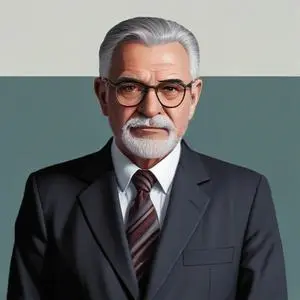
The Unyielding Leader: Yitzhak Shamir's Enduring Legacy
A Militant Zionist and Israel's Seventh Prime Minister
Yitzhak Shamir, born Yitzhak Yezernitsky, is remembered for his unwavering commitment to the Zionist cause and his two terms as Prime Minister of Israel, serving from 1983 to 1984 and again from 1986 to 1992. Throughout his life, Shamir was a vocal advocate for Jewish statehood, often taking unapologetic stances that earned him both admiration and criticism.
Early Life and Revolutionary Ideas
Born on October 22, 1915, in Ruzhany, Poland (now Belarus), Shamir grew up in a traditional Jewish family. He became involved in the Zionist movement at a young age, joining the Betar, a paramilitary wing of the Revisionist Zionist party, led by Zeev Jabotinsky. In 1935, Shamir immigrated to British Palestine, where he worked in an accountant's office and continued to engage in Zionist activism.
The Lehi Years: Militancy and Controversy
During World War II, Shamir's disagreement with the Irgun leadership over supporting the Axis powers led to the formation of the Lehi, also known as the Stern Gang, alongside
Avraham Stern. After Stern's assassination in 1942, Shamir took leadership of Lehi, which carried out acts of violence against British and Arab targets. One of the most notorious incidents was the 1948 Deir Yassin massacre, in which over 100 Palestinians were killed.
Post-Independence and Mossad Years
Following Israel's independence in 1948, Shamir served in Mossad, the Israeli intelligence agency, between 1955 and 1965. He directed Operation Damocles, a covert operation aimed at disrupting German scientists' work on behalf of Egypt. Shamir resigned from Mossad after Prime Minister
David Ben-Gurion ordered an end to the program.
Rise to Political Prominence
In 1969, Shamir joined
Menachem Begin's Herut Party and was first elected to the Knesset in 1973. He served as Speaker of the Knesset from 1977 to 1980, after Likud won the Israeli legislative election. Shamir's Foreign Minister tenure, from 1980 to 1986, was marked by the 1982 Israel-Lebanon War.
Prime Ministerial Tenure and later Life
Shamir's first term as Prime Minister (1983-1984) was marked by economic stagnation and diplomatic tensions. His second term (1986-1992) saw continued conflict with the Palestine Liberation Organization and the Gulf War. Following his retirement from politics, Shamir lived a quiet life, although he continued to comment on political issues until his death on June 30, 2012.
Legacy and Controversy
Shamir's legacy is multifaceted, reflecting both his steadfast commitment to Zionism and his controversial methods. While some view him as a hero and a champion of Jewish statehood, others criticize his involvement in violent acts and his hardline stance on Arab-Israeli relations. Nevertheless, Yitzhak Shamir remains an integral figure in Israel's history, leaving behind a complex and enduring legacy.
- "Nature abhors a vacuum, and so does the Israeli people." - Yitzhak Shamir, on the need for Jewish settlement in the West Bank.
FAQ
What was Yitzhak Shamirs role in Israeli politics?
Yitzhak Shamir was a Belarusian-Israeli civil servant and politician who served as the 7th Prime Minister of Israel from 1983 to 1984 and again from 1986 to 1992. During his tenure, he focused on economic development, national security, and settlement expansion.
What was Yitzhak Shamirs stance on the Israeli-Palestinian conflict?
Yitzhak Shamir was a hardliner on the Israeli-Palestinian conflict, opposing any territorial concessions and advocating for the annexation of the West Bank and Gaza Strip. His policy led to increased tensions with the Arab world and the international community.
How did Yitzhak Shamirs government respond to the First Intifada?
Yitzhak Shamirs government responded to the First Intifada with a heavy hand, using military force to quell the uprising and imposing strict curfews and travel restrictions on Palestinians. The governments response was widely criticized by human rights groups and the international community.
What was Yitzhak Shamirs role in the formation of the Likud party?
Yitzhak Shamir was a founding member of the Likud party and played a key role in shaping its ideology and policies. He was a strong advocate for Jewish settlements in the West Bank and Gaza Strip and opposed any concessions to the Palestinian Authority.
What is Yitzhak Shamirs legacy in Israeli politics?
Yitzhak Shamirs legacy in Israeli politics is that of a hardcore nationalist and security hawk who prioritized Israeli settlements and national security above all else. While his policies were controversial, he remains a significant figure in Israeli history and a champion of Jewish nationalism.