


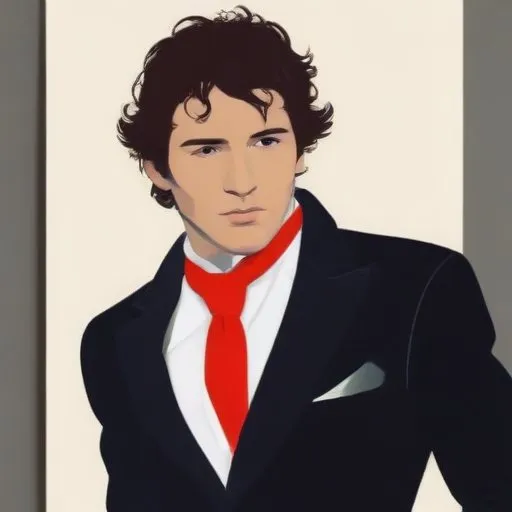
A Regency-era fashion icon who revolutionized men's fashion with his sleek, minimalist style, and was a skilled cricketer.
Beau Brummell is renowned for being the epitome of elegance and refinement in Regency England, dictating the course of British men's fashion for many years. His sartorial influence was so profound that he became synonymous with style and good looks, earning him the title of the "arbiter of men's fashion."
Born on June 7, 1778, in Downing Street, London, George Bryan Beau Brummell was the younger son of William Brummell, Private Secretary to the Prime Minister, Lord North, and Mary ne Richardson. His father's high-ranking position afforded him a privileged upbringing, which would later shape his cultivated tastes and refined sensibilities.
Brummell's close association with the Prince Regent, the future King George IV, catapulted him to the pinnacle of high society. His impeccable dress sense, sharp wit, and charismatic personality made him an indispensable companion to the Prince. For a time, Brummell was the go-to authority on matters of fashion, taste, and etiquette, advising the aristocracy on how to present themselves in public.
Brummell's influence extended beyond the borders of Regency England. His idiosyncratic style, characterized by immaculately tailored clothing, crisp linen, and perfectly coiffed hair, became the benchmark for men's fashion. His fastidious attention to detail earned him both admiration and ridicule, cementing his reputation as a dandy par excellence.
However, Brummell's meteoric rise was matched only by his precipitous fall. A rift with the Prince Regent, compounded by his mounting debts, forced him to flee to France. His once-illustrious life degenerated into poverty and obscurity, culminating in his tragic death in Caen on March 30, 1840, at the age of 61.
Despite his tumultuous life, Brummell's enduring legacy lies in his profound impact on modern society. His influence on men's fashion can be seen in the countless fashion houses, brands, and designers who have borrowed from his aesthetic. His name has become synonymous with style, elegance, and refinement, continuing to inspire generations of fashion enthusiasts.
Brummell's life was not without controversy. His extravagance, perceived arrogance, and scandalous relationships with high-society women earned him criticism from his contemporaries. Despite this, his wit, charm, and unwavering commitment to his artistic vision have cemented his place in history as a true original and a master of his craft.
Brummell's sharp wit and acerbic tongue spawned a plethora of memorable quotes, including:
These pithy sayings offer a glimpse into the complex, enigmatic personality behind the legend, fueling his enduring fascination among historians, fashion enthusiasts, and the general public.
Brummell's life and work embodied a philosophy of elegance, refinement, and beauty. He fervently believed in the transformative power of fashion, arguing that a well-dressed individual could overcome even the most daunting social obstacles. His credo, "A well-tied cravat is the first step to a virtuous life," reflected his conviction that external appearances held the key to inner character.
Brummell's most significant contribution was his pioneering work in establishing men's fashion as a distinct entity, separate from women's fashion. His influence extended to the development of new fabrics, cuts, and styles, which continue to shape men's fashion today.
Brummell's life and work are inextricably linked with the Regency era, a period of great social, cultural, and economic change. His fashion sensibilities, wit, and philosophies continue to captivate audiences, solidifying his position as one of the most original and influential figures in British history.
In conclusion, Beau Brummell's remarkable life, philosophies, and contributions to fashion have left an indelible mark on modern society. His legacy serves as a testament to the enduring power of elegance, refinement, and beauty, inspiring generations to come.
Born in 1788
Romantic poet and playwright celebrated for passionate, expressive works that explored themes of love, freedom, and the human condition.
Born in 1792
Romantic-era writer of lyrical poetry and Gothic dramas that explored the human condition, freedom, and the beauty of nature.
Born in 1795
Romantic poet celebrated for sensual language and vivid imagery, capturing the beauty of nature and human experience in odes like "To Autumn" and "Ode to a Nightingale".
77 Years Old
Acclaimed author of concise, witty, and poignant short stories and novels that explore the complexities of human relationships and the American experience.
