


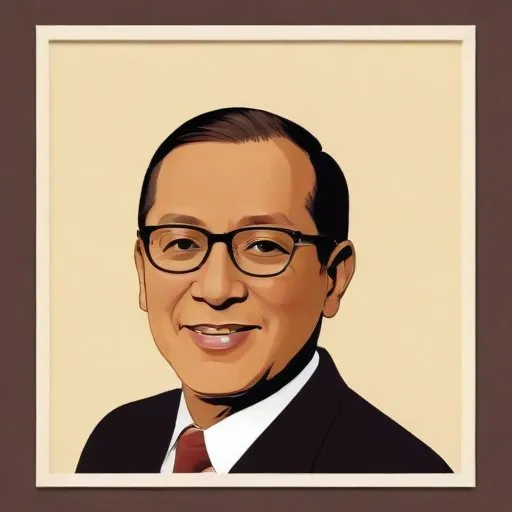
A Filipino journalist and politician who led the opposition against Ferdinand Marcos' regime, known for his courageous fight for democracy and human rights. Assassinated in 1983, his death sparked the People Power Revolution.
Benigno "Ninoy" Aquino Jr. is synonymous with courage and defiance in the face of tyranny. As a prominent critic of Ferdinand Marcos' regime, he was a vocal advocate for democracy and human rights, ultimately giving his life in the fight against oppression.
Born on November 27, 1932, in Concepcion, Tarlac, Philippines, Aquino came from a wealthy and influential family. However, he chose a path of public service, entering politics at the young age of 22. He served as governor of Tarlac province and later as a senator, earning a reputation as a fearless and incorruptible leader.
Aquino was a vocal critic of Marcos' authoritarian rule, speaking out against corruption, human rights abuses, and election fraud. His vocal opposition earned him multiple arrests, torture, and eventually, a death sentence. Despite the risks, he continued to push for democratic reforms, inspiring a generation of Filipinos to stand up against the oppressive regime.
On August 21, 1983, Aquino returned to Manila from exile, hoping to negotiate democratic reforms with Marcos. However, he was assassinated at the Manila International Airport, sparking widespread outrage and protests across the country. His death galvanized the opposition, paving the way for the People Power Revolution that toppled Marcos in 1986.
Aquino's sacrifice did not go in vain. His wife, Corazon Aquino, became the first female president of the Philippines, leading the country towards democracy and healing. Their son, Benigno "Noynoy" Aquino III, also became president, continuing his father's legacy of fighting against corruption and promoting good governance.
Aquino was deeply influenced by his Catholic faith, which guided his commitment to social justice and human rights. He believed in the power of non-violent resistance, often quoting Mahatma Gandhi and Martin Luther King Jr. as inspirations. His philosophy of active non-violence continues to inspire Filipinos and people around the world.
"The Filipino is worth dying for," Aquino once said, encapsulating his unwavering dedication to his people. Another famous quote, "I am not afraid, because I know that I am doing the right thing," underscores his courage in the face of adversity.
Aquino's life and death played a pivotal role in shaping Philippine history. He was a beacon of hope during a dark period of martial law, and his sacrifice paved the way for democratic reforms. Today, he is remembered as a national hero, with his birthday, November 27, declared a national holiday.
Aquino's commitment to democracy and human rights puts him in the same league as other notable figures like Nelson Mandela and Aung San Suu Kyi. Like them, he fought against oppressive regimes, inspiring a generation to stand up for their rights.
Did you know that Aquino was a journalist before entering politics? He worked as a war correspondent during the Korean War and later became the editor-in-chief of the Manila Times.
Aquino's life was a testament to his unwavering commitment to democracy and human rights. His sacrifice continues to inspire Filipinos and people around the world, reminding us of the power of courage and conviction in the face of adversity.
93 Years Old
First female president of the Philippines, led the People Power Revolution, and restored democracy after decades of authoritarian rule.
Born in 1917
A Filipino leader who ruled with an iron fist, implementing martial law and amassing wealth, leaving a legacy of controversy and economic turmoil.
97 Years Old
The 10th First Lady of the Philippines, known for her extravagant lifestyle and shoe collection, which symbolized the excesses of her husband's corrupt regime. She was a powerful figure in her own right, with a strong influence on politics and fashion.
89 Years Old
The 13th President of the Philippines, a former actor turned politician, is known for his populist appeal and controversial presidency marked by corruption allegations and an eventual impeachment trial. He's also remembered for his efforts to address poverty and inequality.
79 Years Old
The 14th President of the Philippines, a prominent figure in Southeast Asian politics, known for her economic reforms and controversial tenure marked by allegations of corruption and human rights abuses.
98 Years Old
The 12th President of the Philippines, a decorated war hero and leader who implemented economic reforms and brought stability to the country after a tumultuous era. He's known for his efforts to modernize the Philippines and promote national unity.
Born in 1924
A former Philippine Defense Minister and Senator who played a key role in the country's martial law era and the People Power Revolution that toppled Ferdinand Marcos' regime. He's also known for his controversial legacy and disputed claims of being a hero or a villain.
