


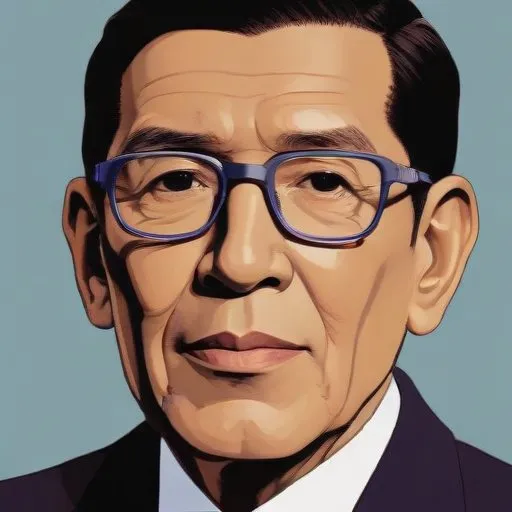
A former Philippine Defense Minister and Senator who played a key role in the country's martial law era and the People Power Revolution that toppled Ferdinand Marcos' regime. He's also known for his controversial legacy and disputed claims of being a hero or a villain.
Known for his pivotal role in shaping the course of Philippine history, Juan Ponce Enrile is a Filipino politician and lawyer who has left an indelible mark on the country's political landscape. From his significant contributions to the administration of President Ferdinand Marcos to his instrumental role in the 1986 People Power Revolution, Enrile's eventful career has been nothing short of remarkable.
Enrile's rise to prominence began under the patronage of President Ferdinand Marcos, where he served as Justice Secretary and Defense Minister. During this period, he played a crucial role in planning and implementing Martial Law, which lasted from 1972 to 1981. As the head of the Philippine Military, Enrile oversaw the implementation of Martial Law, a period marked by both economic growth and human rights abuses.
Enrile's influence extended beyond the military sphere. He also served as the President of the Philippine Coconut Authority, allowing him to gain control of the lucrative copra industry alongside Danding Cojuangco. Furthermore, he was entrusted with the responsibility of overseeing logging operations in the Philippines, a sector that experienced rapid growth during the Martial Law era.
By the 1980s, Enrile's influence within the Marcos administration began to wane due to rising factionalism. This led him to orchestrate a plot to overthrow Marcos in February 1986. Although the initial plan was foiled, Enrile and his allies, including General Fidel Ramos, rallied support from other units of the Armed Forces of the Philippines and ultimately withdrew their support for Marcos. This pivotal moment marked the beginning of the end of Marcos' regime and paved the way for the People Power Revolution.
Enrile has served four terms in the Philippine Senate, amassing a total of 22 years of service. He holds the distinction of having the third-longest tenure in the history of the upper chamber. In 2022, at the remarkable age of 98, Enrile returned to government office as the Chief Presidential Legal Counsel in the administration of President Bongbong Marcos.
Enrile's legacy is complex and multifaceted. While he has been praised for his role in the People Power Revolution, he has also faced criticism for his involvement in human rights abuses during the Martial Law era. His control of the logging industry has been cited as a contributing factor to the Philippines' rampant deforestation. Despite these controversies, Enrile remains an important figure in Philippine politics, with a career spanning over seven decades.
Throughout his long and storied career, Juan Ponce Enrile has been a maverick of Philippine politics. Love him or loathe him, his influence on the country's history is undeniable. As a lawyer, politician, and statesman, Enrile's life has been marked by both triumph and controversy. Yet, his unwavering dedication to public service remains an inspiration to generations of Filipinos.
Born in 1917
A Filipino leader who ruled with an iron fist, implementing martial law and amassing wealth, leaving a legacy of controversy and economic turmoil.
93 Years Old
First female president of the Philippines, led the People Power Revolution, and restored democracy after decades of authoritarian rule.
93 Years Old
A Filipino journalist and politician who led the opposition against Ferdinand Marcos' regime, known for his courageous fight for democracy and human rights. Assassinated in 1983, his death sparked the People Power Revolution.
98 Years Old
The 12th President of the Philippines, a decorated war hero and leader who implemented economic reforms and brought stability to the country after a tumultuous era. He's known for his efforts to modernize the Philippines and promote national unity.
89 Years Old
The 13th President of the Philippines, a former actor turned politician, is known for his populist appeal and controversial presidency marked by corruption allegations and an eventual impeachment trial. He's also remembered for his efforts to address poverty and inequality.
79 Years Old
The 14th President of the Philippines, a prominent figure in Southeast Asian politics, known for her economic reforms and controversial tenure marked by allegations of corruption and human rights abuses.
66 Years Old
The 15th President of the Philippines, a key figure in the country's struggle for democracy and corruption reform, known for his efforts to rebuild the economy and promote good governance.
81 Years Old
A trailblazing Filipino judge and politician who championed anti-corruption efforts and advocated for human rights, earning her a nomination for the Nobel Peace Prize. She was a strong voice for justice and reform in her country.
