


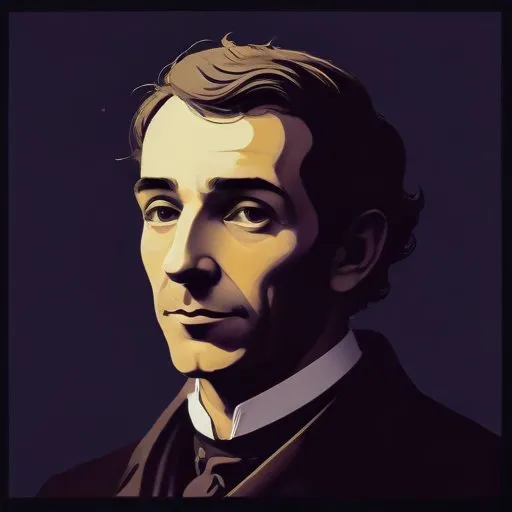
A French astronomer and academic who made significant contributions to the field of astronomy, particularly in the study of celestial mechanics and the discovery of asteroids. He was also a pioneer in the development of astronomical photography.
Benjamin Baillaud, a renowned French astronomer, left an indelible mark on the field of celestial mechanics and beyond. He is best known for his pioneering work on the Carte du Ciel project, a monumental undertaking that aimed to map the entire sky.
Born on February 14, 1848, in Chalons-sur-Saône, France, Baillaud's fascination with the night sky began early. He pursued his passion at the École Normale Supérieure (1866-1869) and later at the University of Paris.
Baillaud's professional journey began as an assistant at the Paris Observatory in 1872, where he honed his skills in celestial mechanics. His expertise led him to become the director of the Toulouse Observatory from 1878 to 1907, during which he also served as the Dean of the University of Toulouse's Faculty of Science.
His tenure at Toulouse was marked by significant achievements, including the expansion of the observatory and his unwavering support for the Carte du Ciel project. Baillaud's groundbreaking work on the motions of Saturn's satellites further solidified his reputation as a leading astronomer of his time.
In 1903, Baillaud spearheaded the establishment of a new facility on the Pic du Midi in the Pyrenees, which boasted a 0.5-meter reflecting telescope and a 0.25-meter refracting telescope. This feat required the collaboration of soldiers and ingenuity to overcome the challenges posed by the site's 2,865-meter altitude.
In 1907, Baillaud became the director of the Paris Observatory, where he revitalized the Carte du Ciel project with a grand conference. His efforts secured government funding, but ultimately, the project's ambitions proved unrealistic.
Baillaud's commitment to the astronomical community extended beyond his directorial roles. He served as the President of the Société Astronomique de France (SAF) from 1909 to 1911 and founded the International Time Bureau, pioneering the transmission of a time signal from the Eiffel Tower.
Throughout World War I, Baillaud ensured the continuity of the observatory and the time signal, demonstrating his dedication to the pursuit of scientific knowledge.
Benjamin Baillaud's contributions to astronomy, time standardization, and scientific leadership have left an indelible mark on the world of science. His legacy serves as a testament to the power of human curiosity and the boundless potential of the human spirit.
As we gaze up at the stars, we are reminded of the invaluable work of pioneers like Benjamin Baillaud, whose discoveries continue to inspire and awe us today.
Born in 1749
Developed nebular hypothesis of the origin of the solar system and formulated Laplace's equation, a fundamental concept in mathematics and physics. He's considered the founder of celestial mechanics.
Born in 1811
Predicted the existence and location of Neptune, a previously unknown planet, through mathematical calculations, revolutionizing astronomy.
Born in 1842
A French astronomer and author who wrote about the wonders of the universe, making astronomy accessible to the general public through his popular science books. He's also known for his work on the possibility of life on other planets.
Born in 1854
A pioneer in mathematics and physics, he laid the foundations for modern chaos theory, topology, and relativity, making groundbreaking contributions to our understanding of space and time.
Born in 1774
A French polymath who made significant contributions to the fields of physics, astronomy, and mathematics, particularly in the discovery of chromatic polarization and the Biot-Savart law.
Born in 1786
A mathematician and politician who made significant contributions to the development of electromagnetism and served as Prime Minister of France, advocating for social reform and education.
Born in 1592
A 17th-century polymath who made significant contributions to the scientific revolution, merging ancient Greek philosophy with modern scientific methods, and providing a foundation for modern astronomy. He's also known for his work on the concept of the vacuum and the behavior of gases.
