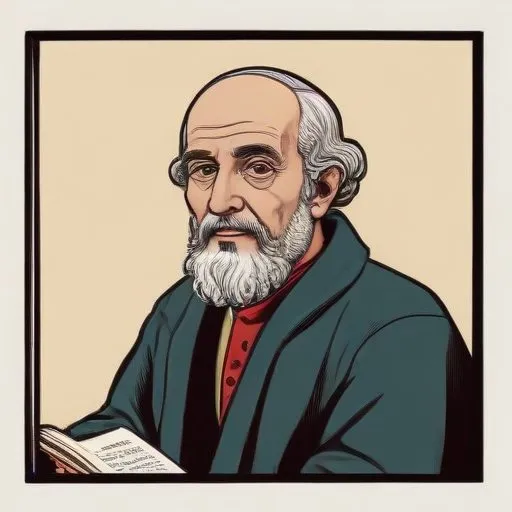
Pierre Gassendi: The French Philosopher and Polymath
The First to Formulate the Modern Scientific Outlook
Pierre Gassendi, a 17th-century French philosopher, Catholic priest, astronomer, and mathematician, is renowned for being one of the first thinkers to formulate the modern scientific outlook. He is credited with developing a philosophy that balanced skepticism with empiricism, a approach that would go on to shape the course of scientific inquiry for centuries to come.
Early Life and Education
Gassendi was born on January 22, 1592, in Champtercier, near Digne, France, to Antoine Gassend and Françoise Fabry. His early education was entrusted to his maternal uncle, Thomas Fabry, the curé of the church of Champtercier. A youthful prodigy, Gassendi showed academic potential and attended the collège (town high school) at Digne, where he displayed a particular aptitude for languages and mathematics.
Academic Pursuits and Career Highlights
In 1609, Gassendi entered the University of Aix-en-Provence, where he studied philosophy under Philibert Fesaye, O.Carm. at the Collège Royal de Bourbon (the Faculty of Arts of the University of Aix). In 1612, the college of Digne called him to lecture on theology. While at Digne, he traveled to Senez, where he received minor orders from Bishop
Jacques Martin. In 1614, he received the degree of Doctor of Theology from the University of Avignon, and was elected Theologian in the Cathedral Chapter of Digne.
Astronomical Contributions and the Transit of Mercury
Gassendi was an active observational scientist, and his most notable contribution to astronomy was the publication of the first data on the transit of Mercury in 1631. This groundbreaking work showcased his ability to combine theoretical knowledge with practical observation, earning him recognition in the scientific community.
Philosophical Contributions and Beliefs
Gassendi's philosophical works aimed to reconcile Epicurean atomism with Christianity, a challenging endeavor that demonstrated his commitment to finding a middle ground between skepticism and dogmatism. His moderate skepticism and empiricism paved the way for future scientists to adopt a more nuanced approach to knowledge acquisition.
Influence on Modern Society and Legacy
The lunar crater Gassendi is named in his honor, a testament to his lasting impact on the scientific community. Richard Popkin, a renowned philosopher, credited Gassendi with being one of the first thinkers to formulate the modern scientific outlook, an approach that continues to shape scientific inquiry to this day.
Personal Milestones and Key Life Events
- 1617: Received holy orders from the Bishop of Digne.
- 1631: Published the first data on the transit of Mercury.
- 1648: Became a leader of a group of freethinking intellectuals in Paris.
Comparative Analysis with Contemporaries
Gassendi's philosophical approach clashed with that of his contemporary,
René Descartes, who advocated for the possibility of certain knowledge. This intellectual debate highlights the diversity of thought during the 17th century and underscores Gassendi's commitment to finding a balanced approach to knowledge acquisition.
Final Years and Legacy
Pierre Gassendi passed away on October 24, 1655, leaving behind a rich legacy that continues to inspire scientists and philosophers. His work remains a testament to the power of balancing skepticism with empiricism, and his influence on modern society is a lasting tribute to his intellectual prowess.
FAQ
Who was Pierre Gassendi and what were his contributions to science and philosophy?
Pierre Gassendi was a French mathematician, astronomer, and philosopher who made significant contributions to science and philosophy, including the development of the scientific method, and the establishment of the foundations of modern astronomy.
What was Pierre Gassendis role in the development of the scientific method?
Pierre Gassendi played a significant role in the development of the scientific method, advocating for the use of empirical evidence, experimentation, and inductive reasoning in scientific inquiry.
How did Pierre Gassendis work in astronomy shape our understanding of the universe?
Pierre Gassendis work in astronomy had a profound impact on our understanding of the universe, including the discovery of the planet Mercury, and the development of new theories about the nature of the universe.
What was Pierre Gassendis contribution to the development of Epicurean philosophy?
Pierre Gassendi was a key figure in the development of Epicurean philosophy, reviving interest in the ancient Greek philosopher Epicurus, and adapting his ideas to the scientific and philosophical debates of the 17th century.
What is Pierre Gassendis legacy in modern science and philosophy?
Pierre Gassendis legacy in modern science and philosophy is that of a pioneering thinker who helped establish the foundations of modern astronomy, and whose ideas about the scientific method and Epicurean philosophy continue to influence scientific inquiry and philosophical debate today.