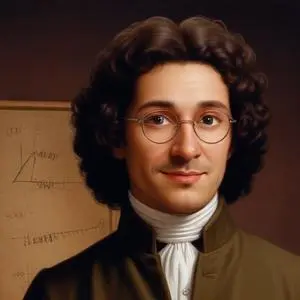
Evangelista Torricelli: The Italian Genius Behind the Barometer
A Legacy of Innovation
Evangelista Torricelli, an Italian physicist and mathematician, is renowned for inventing the barometer, a device that measures atmospheric pressure. This groundbreaking innovation revolutionized the field of physics, allowing scientists to better understand the behavior of gases and paving the way for major advancements in meteorology and engineering.
Early Life and Education
Born on October 15, 1608, in Rome, Italy, Torricelli was the firstborn child of Gaspare Torricelli and Caterina Angetti. Despite his family's poverty, his parents recognized his exceptional talents and sent him to study in Faenza, where he received a sound basic education under the care of his uncle, Giacomo James, a Camaldolese monk. Torricelli then entered a Jesuit College in 1624 to study mathematics and philosophy, and later, he was sent to Rome to study science under the Benedictine monk Benedetto Castelli, a student of Galileo Galilei.
The Making of a Genius
It was in Rome that Torricelli's intellectual prowess truly flourished. He worked as Castelli's secretary from 1626 to 1632, during which time he was exposed to experiments funded by
Pope Urban VIII. This exposure had a profound impact on Torricelli's development as a scientist, and he soon became fascinated with the study of gases and the behavior of fluids. His work with Castelli and his friendship with fellow students Raffaello Magiotti and Antonio Nardi laid the foundation for his future accomplishments.
The Birth of the Barometer
Torricelli's most notable contribution to science came in 1643, when he invented the mercury barometer. By filling a glass tube with mercury and inverting it into a dish of mercury, Torricelli created a device that could measure atmospheric pressure with unprecedented accuracy. This invention not only earned him recognition from the scientific community but also paved the way for significant advancements in meteorology and engineering.
Advances in Optics and Indivisibles
Torricelli's contributions to science extended far beyond his invention of the barometer. He made significant advances in the field of optics, working on the design of lenses and mirrors, and laid the groundwork for the development of telescopes and microscopes. Additionally, his work on the method of indivisibles, a precursor to integration, helped lay the foundation for the development of calculus.
Torricelli's impact on modern society cannot be overstated. The barometer, his most famous invention, has become an indispensable tool in meteorology and is still used today to predict weather patterns. His work in optics and indivisibles has had far-reaching implications for fields such as astronomy, biology, and physics. In recognition of his contributions, the unit of measurement for atmospheric pressure, the torr, is named after him.
Personal Milestones and Key Life Events
- 1624: Entered Jesuit College to study mathematics and philosophy
- 1626: Began working as Benedetto Castelli's secretary in Rome
- 1632: Ended his tenure as Castelli's secretary
- 1643: Invented the mercury barometer
- 1647: Died on October 25, at the age of 39
Trivia and Fun Facts
- Torricelli was known for his exceptional skills in mathematics and his ability to solve complex problems
- He was a close friend and admirer of Galileo Galilei
- The barometer was initially called the "torricellian tube" in his honor
Influence on Pop Culture
Torricelli's invention of the barometer has had a lasting impact on popular culture. From meteorological forecasts to sci-fi depictions of futuristic technologies, the barometer has become an iconic symbol of scientific ingenuity and innovation.
Awards and Honors
- The unit of measurement for atmospheric pressure, the torr, is named after him
- A crater on the moon, Torricelli, is named in his honor
Conclusion
Evangelista Torricelli's legacy is a testament to the power of human ingenuity and innovation. Through his groundbreaking work, he has left an indelible mark on the scientific community, and his contributions continue to influence and inspire generations of scientists and engineers.
FAQ
What was Evangelista Torricellis contribution to the field of physics?
Torricelli is credited with inventing the mercury barometer, which allowed for accurate measurement of atmospheric pressure. He also made significant contributions to the study of fluid dynamics and hydrostatics.
How did Evangelista Torricellis work influence the development of modern science?
Torricellis innovations in measurement and experimentation paved the way for later scientists like Pascal and Boyle. His work on the behavior of gases and fluids laid the foundation for modern physics and engineering.
What were Evangelista Torricellis views on the nature of the vacuum?
Torricelli was one of the first scientists to propose the existence of the vacuum, challenging Aristotelian views on the impossibility of a vacuum. He demonstrated the possibility of creating a vacuum using his barometer experiments.
How did Evangelista Torricellis work impact the development of engineering and technology?
Torricellis innovations had significant practical applications in engineering and technology, from the design of water pumps and irrigation systems to the development of precision instruments and machines.
What is Evangelista Torricellis legacy in modern science?
Torricellis groundbreaking work on the behavior of fluids and gases continues to influence modern science and engineering. His legacy is commemorated in the unit of pressure, the torr, which bears his name.