


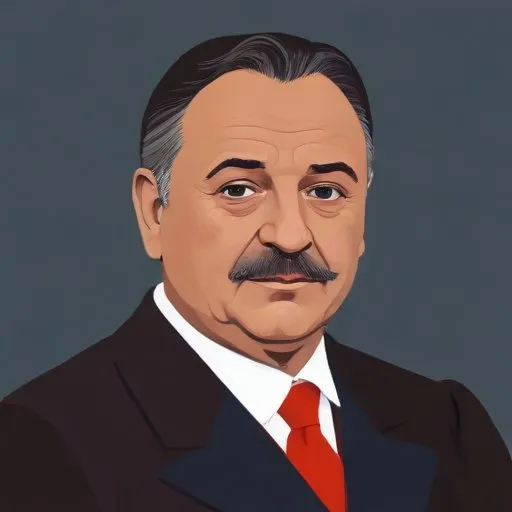
A 19th-century Hungarian poet and politician who served as the country's 3rd Prime Minister, known for his role in the Hungarian Revolution of 1848 and his literary works.
Bertalan Szemere, a Hungarian poet and nationalist, is best known for becoming the third Prime Minister of Hungary during the short-lived Hungarian Revolution of 1848. This pivotal moment in Hungarian history saw the country briefly gain independence from the Austrian Empire, and Szemere played a crucial role in shaping the revolution's ideals and outcomes.
Szemere was born on August 27, 1812, in Vatta, Hungary, into a poor noble family with roots tracing back to the 9th-century chieftain Huba. His parents, László Szemere and Erzsébet Karove, instilled in him a love for literature and poetry. Szemere's early education in Miskolc, Késmárk, and Sárospatak laid the foundation for his later literary pursuits.
During his formative years, Szemere was deeply influenced by prominent Hungarian poets Ferenc Kölcsey and Mihály Vörösmarty. Their works not only shaped his writing style but also instilled in him a strong sense of national pride and liberal ideals.
In 1832, Szemere graduated as a jurist and began working as an apprentice in Pressburg (now Bratislava, Slovakia). Here, he became a member of the Parliamentary Young Members Group, advocating for liberal principles and social reform. After completing his pupillage, Szemere returned to Borsod, where he was elected as an honorary notary public.
In 1835, Szemere embarked on a journey across Europe, visiting cities such as Berlin, Amsterdam, Dublin, Lausanne, Paris, and London. During his travels, he was struck by the underdevelopment of Hungary compared to other European countries and the prejudices held against the Hungarian people. Szemere documented his experiences, observations, and insights in his diary, Utazás külföldön (Travelling Abroad), published in 1840.
Szemere's travel diary made him an overnight sensation, earning him membership in the Hungarian Academy of Sciences. Between 1841 and 1847, he served as a judge in Borsod county, during which time he became a congressman in Pressburg, alongside László Palczy. Szemere's rising profile led to his leadership role in the Opposition (1843-1866) and the 1847-1848 Diet.
In 1848, Szemere became the third Prime Minister of Hungary, playing a crucial role in shaping the country's brief period of independence. His leadership and commitment to liberal ideals made him a key figure in the Hungarian Revolution, earning him a place in the annals of Hungarian history.
Bertalan Szemere's contributions to Hungarian literature, politics, and society are undeniable. His travel diary not only exposed the country's underdevelopment but also sparked a sense of national pride and urgency for reform. As Prime Minister, Szemere's leadership paved the way for future generations of Hungarian politicians and thinkers. Today, he is remembered as a champion of liberal ideals, national unity, and progress.
Born in 1803
A Hungarian statesman who played a key role in the country's unification with Austria, creating the dual monarchy of Austria-Hungary in 1867. He's known for his efforts to establish a constitutional government and promote national unity.
Born in 1875
The first president of the Hungarian Republic, known for leading the country's transition from monarchy to democracy after World War I. He played a key role in shaping Hungary's modern political landscape.
