


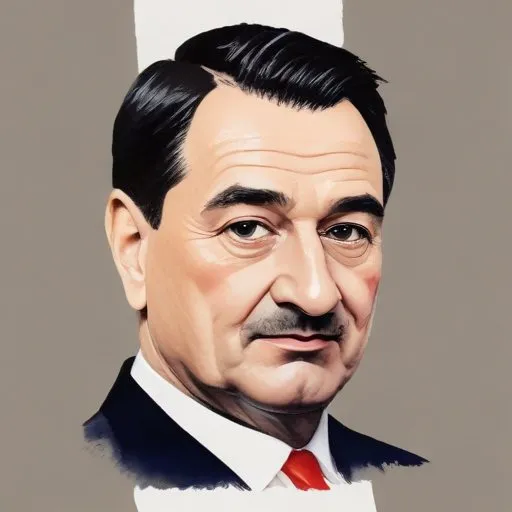
A Hungarian statesman who played a key role in the country's unification with Austria, creating the dual monarchy of Austria-Hungary in 1867. He's known for his efforts to establish a constitutional government and promote national unity.
Ferenc Dek, also known as Francis Deak or Franjo Dek, was a Hungarian statesman and Minister of Justice who left an indelible mark on Hungarian history. He is renowned for his instrumental contributions to major events, including the April Laws, the Austro-Hungarian Compromise of 1867, and the Hungarian Nationalities Law of 1868.
Born on October 17, 1803, in Sjtr, southwestern Hungary, Dek belonged to an ancient noble family. His father, Ferenc Dek de Kehida, was a jurist and landowner, while his mother, Erzsbet Sibrik de Szarvaskend et Vr, was a noble lady. Dek studied law and became a successful advocate and notary, establishing his reputation in the legal fraternity.
In 1833, Dek attended the assembly of Pressburg (now Bratislava) as a replacement for his older brother Antal Dek de Kehida, marking the beginning of his illustrious political career. His involvement in the suit of Mikls Wesselnyi and his success in declaring the Hungarian Assembly's right to create laws made his name familiar in important circles.
In 1836, Dek wrote and distributed a document outlining the causes he supported, without the permission of the censors. Although the document was confiscated, it had already gained widespread attention, making Dek a familiar name in influential circles. During the Diet of 1839-1840, Dek succeeded in bringing about an understanding between different factions, showcasing his ability to find common ground.
Dek's most notable achievements include:
Dek was a firm believer in the importance of finding middle ground and compromise. He advocated for reformist policies, but also recognized the need to balance competing interests. His commitment to finding reasonable solutions earned him the nickname "The Wise Man of the Nation."
Dek's contributions to Hungarian history have had a lasting impact on modern society. His ability to navigate complex political situations and find compromises has inspired generations of politicians and statesmen. His legacy serves as a testament to the power of diplomacy and cooperation.
Dek's life was marked by significant milestones, including:
Ferenc Dek's life and achievements serve as a testament to the power of diplomacy, compromise, and cooperation. His influence on Hungarian history and modern society is undeniable, earning him a place among the most important figures in Hungarian politics and reforms of the 19th century.
Born in 1803
A Hungarian statesman who played a key role in the country's unification with Austria, creating the dual monarchy of Austria-Hungary in 1867. He's known for his efforts to establish a constitutional government and promote national unity.
Born in 1890
The 33rd Prime Minister of Hungary, a politician and diplomat who served during World War II and was involved in the country's fascist regime. He is known for his role in Hungary's involvement in the war and the subsequent war crimes trials.
Born in 1868
Led a right-wing authoritarian government in Hungary between the two World Wars, known for his anti-Semitic and nationalist policies. He collaborated with Nazi Germany during World War II.
