


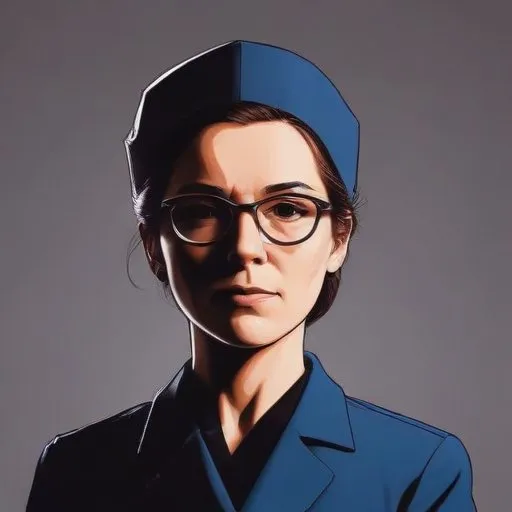
Pioneering female electrical engineer who broke gender barriers in the male-dominated field, making significant contributions to the development of electrical systems.
Bertha Lamme Feicht was a pioneering American engineer who made history in 1893 by becoming the first woman to graduate from Ohio State University with a degree in mechanical engineering, specializing in electricity. This remarkable achievement marked her as the first American woman to earn a degree in a main discipline of engineering other than civil engineering, paving the way for future generations of female engineers.
Born on December 16, 1869, on her family's farm in Bethel Township, near Springfield, Ohio, Bertha Lamme grew up with a curiosity for how things worked. She attended Olive Branch High School, graduating in 1889, before enrolling at Ohio State University that same fall.
Her academic prowess and interest in engineering led her to follow in her brother's footsteps, Benjamin G. Lamme, who was also an engineer. Bertha's hard work and dedication paid off, culminating in her graduation in 1893 with a degree in mechanical engineering, with a specialty in electricity. Her thesis, titled "An Analysis of Tests of a Westinghouse Railway Generator," showcased her expertise in the field.
Following her graduation, Bertha was hired by Westinghouse as its first female engineer, a testament to her exceptional skills and knowledge. She worked alongside her future husband, Russell S. Feicht, a fellow Ohio State alumnus and her supervisor, until they married in 1905.
Bertha's remarkable career and achievements inspired future generations of women in engineering. Today, her personal effects, including her slide rule, T-square, and diploma, are housed in the collections of the Heinz History Center in Pittsburgh, serving as a testament to her groundbreaking contributions to the field.
Bertha and Russell had one child, Florence, born in 1910, who inherited her mother's passion for science and went on to become a physicist for the U.S. Bureau of Mines.
Bertha Lamme Feicht passed away on November 20, 1943, in Pittsburgh, leaving behind a legacy that continues to inspire women in engineering today. Her husband, Russell, died in April 1949.
In recognition of Bertha's pioneering achievements, the Westinghouse Educational Foundation, in conjunction with the Society of Women Engineers, established a scholarship in her name in 1973. This scholarship continues to support and empower women in engineering, ensuring that Bertha's legacy lives on.
Born in 1856
A pioneering engineer who harnessed the power of alternating current (AC) to transform the world's electrical systems, and is credited with developing groundbreaking technologies like radio communication and X-ray imaging.
Born in 1847
A pioneer in innovation, credited with developing groundbreaking inventions that revolutionized the way people live and communicate, including the light bulb and phonograph.
Born in 1846
Developed innovative braking systems for trains, revolutionizing rail safety and transforming the industry. Founded a company that dominated the market for over a century.
Born in 1847
A Scottish-American engineer and academic credited with inventing the telephone, revolutionizing real-time communication. This innovation transformed the way people connect and conduct business.
Born in 1853
Developed groundbreaking inventions and innovations in electrical engineering, including the first practical welding machine and the first electric streetcar system.
Born in 1856
Developed over 60 patents, including the first electric trolley system and improvements to the railroad industry, revolutionizing transportation in the late 19th century.
Born in 1873
Invented the Audion tube, a type of vacuum tube that revolutionized radio communication and paved the way for modern electronics. This innovation enabled the amplification of weak electrical signals, transforming the field of communication.
Born in 1791
Pioneering scientist who discovered electromagnetic induction, formulated the laws of electrolysis, and invented the first electrical generator, revolutionizing our understanding of electricity and its applications.
