


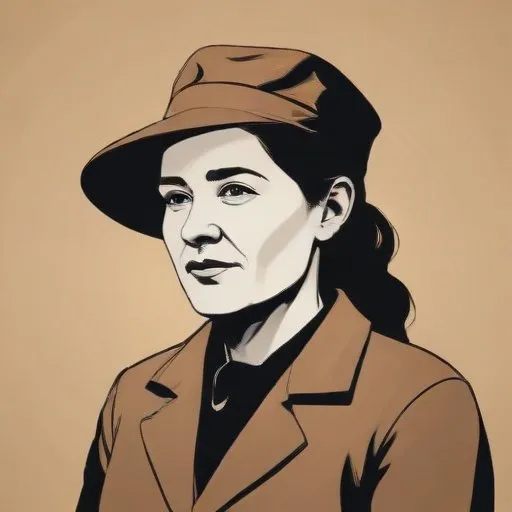
One of the first Native American women to work as an archaeologist, she contributed significantly to the field of Southwest archaeology, particularly in the study of California's Native American cultures.
Bertha Parker Pallan, an American archaeologist of Abenaki and Seneca descent, is widely regarded as the first Native American female archaeologist. Born in 1907, she dedicated her life to uncovering the secrets of the past, working as an assistant in archaeology at the Southwest Museum.
Bertha's earliest years were marked by a strong connection to her cultural heritage and a fascination with the ancient world. Her father, Arthur C. Parker, was an archaeologist and the first president of the Society for American Archaeology, and she often assisted him on excavations as a child. This exposure sparked a lifelong passion for archaeology, which she would later pursue as a career.
Bertha's professional journey began in the early 1920s, when she moved to Nevada to work on an archaeological site for the Southwest Museum. Under the direction of Mark Raymond Harrington, she honed her skills and developed a reputation as a skilled archaeologist. Her work took her to various sites, including the Gypsum Cave expedition, where she met her second husband, paleontologist James Thurston.
Bertha's personal life was marked by both joy and tragedy. She married twice, first to Joseph Pallan, with whom she had a daughter, Wilma Mae Billie Pallan, and later to James Thurston. However, her second marriage was cut short when Thurston died suddenly from a heart attack during an expedition. Bertha's own health suffered as a result of her work in the Gypsum Caves, where she was exposed to large amounts of cave guano, forcing her to take a break from her work.
Bertha Parker Pallan's groundbreaking work paved the way for future generations of Native American women in archaeology. Her contributions to the field are a testament to her dedication and perseverance. As a pioneering figure, she broke down barriers and challenged stereotypes, inspiring others to follow in her footsteps.
Although Bertha Park Pallan's work went largely unrecognized during her lifetime, her legacy has been rediscovered and celebrated in recent years. Her contributions to the field of archaeology are now widely acknowledged, and she is recognized as a trailblazing figure in the history of American archaeology.
Born in 1913
A pioneering archaeologist and anthropologist who uncovered crucial fossils and artifacts in Africa, shedding light on human evolution and ancient cultures.
Born in 1903
A pioneering palaeontologist and archaeologist who uncovered crucial evidence of human evolution in Africa, shedding light on the origins of humanity.
81 Years Old
A renowned Kenyan paleontologist and politician, he led expeditions that uncovered significant fossil discoveries, including early human ancestors, and later fought against elephant poaching and corruption.
Born in 1893
Discovered the first early human species, Australopithecus africanus, and introduced the concept of "killer ape" theory, which suggests that human evolution was driven by violence and aggression.
Born in 1909
Developed structural linguistics and pioneered the use of mathematical models in linguistics, revolutionizing the field with his work on syntax and semantics.
