


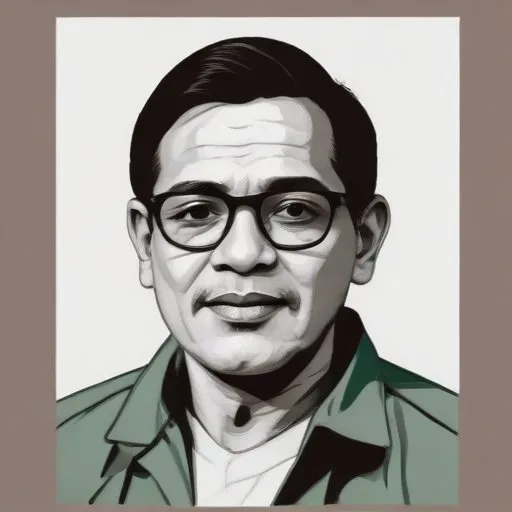
A Bangladeshi peasant leader who organized rural peasants to fight against the exploitation of landlords and moneylenders, leading to significant land reforms.
Binod Bihari Chowdhury, a stalwart of the Indian independence movement, is primarily recognized for his pivotal role in the Chittagong armoury raid, a daring armed resistance movement against British colonial rule in 1930, led by the legendary Surya Sen.
This momentous event, aimed at uprooting the British colonial regime from British India, cemented Chowdhury's position as a resolute anticolonial revolutionary, earning him widespread recognition in the history of Bangladesh.
Binod Bihari Chowdhury was born on January 10, 1911, in the village of Uttarvurshi, Chittagong district, which was then part of the East Bengal and Assam province of British India. He was the fifth child of his parents, Kamini Kumar Chowdhury and Roma Rani Chowdhury, with his father being a lawyer in Chittagong.
Chowdhury's educational journey began at the Rangamatia Board School in Fatikchhari Upazila, followed by his matriculation from Saroatoli High School, where he secured a scholarship for his exceptional performance in 1929. He later went on to obtain his Bachelor of Arts, Master of Arts, and Bachelor of Law degrees in 1934, 1936, and 1939, respectively, while incarcerated at the Duly Detention Camp.
In 1927, Chowdhury joined the anti-British revolutionary group, Jugantar, where he came into contact with Surya Sen, who was planning an armed uprising against the British Raj in Chittagong. This marked the beginning of Chowdhury's involvement in the Indian independence movement, which would define his life's work.
The Chittagong armoury raid, a pivotal event in the Indian independence movement, was a bold attempt to capture the two main armouries in Chittagong, thereby weakening the British colonial rule. Although the raid ultimately failed, it served as a catalyst for the movement, inspiring a new wave of revolutionaries to take up the fight against colonial oppression.
In recognition of his unwavering dedication to the Indian independence movement, Chowdhury was awarded the Independence Day Award in 2000, the highest civilian honor in Bangladesh.
As the last surviving revolutionary from the Chittagong armoury raid, Chowdhury's life and work have left an indelible mark on the history of Bangladesh. His unrelenting commitment to the cause of independence has inspired generations of revolutionaries, freedom fighters, and social workers, solidifying his position as a stalwart of the Indian independence movement.
Through his life's work, Chowdhury has demonstrated the power of unwavering dedication, inspiring future generations to strive for a world free from colonial oppression and social injustice.
Born in 1869
Indian freedom fighter, activist, and philosopher who led India to independence from British rule through non-violent civil disobedience, inspiring civil rights movements worldwide.
Born in 1918
A South African lawyer and politician who fought against apartheid, becoming the country's first black president and a symbol of racial reconciliation, earning a Nobel Peace Prize. He's a beacon of hope and freedom.
97 Years Old
A prominent leader in the civil rights movement, advocating for racial equality and social justice through nonviolent means, leaving a lasting impact on American history.
81 Years Old
A democracy icon and human rights activist, she led the fight against Myanmar's military rule and was awarded the Nobel Peace Prize in 1991.
29 Years Old
A courageous advocate for girls' education, particularly in her native Swat Valley, who survived a Taliban assassination attempt and continues to inspire global change through her activism and writing.
Born in 1913
Refused to give up her seat on a Montgomery, Alabama bus to a white person, sparking the Montgomery Bus Boycott, a pivotal event in the Civil Rights Movement.
95 Years Old
A prominent religious leader and human rights advocate who fought against apartheid and racism, known for his tireless efforts to promote equality and forgiveness.
86 Years Old
A pioneering African woman who fought to protect the environment and promote democracy, earning her the Nobel Peace Prize for her groundbreaking efforts.
