


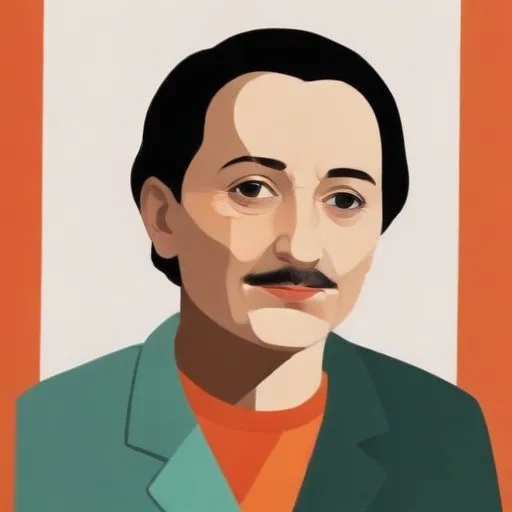
A Hungarian poet and critic who wrote influential film theory and was a key figure in the development of cinematic language, known for his work on film aesthetics and narrative structure.
Béla Balázs, born Herbert Bauer, was a Hungarian film critic, aesthetician, writer, and poet of Jewish heritage, renowned for his contributions to formalist film theory. His work, spanning multiple genres, has left an indelible mark on the cinematic landscape.
Balázs was born on August 4, 1884, in Szeged, Hungary, to Simon Bauer and Eugenia Lwy. He adopted the nom de plume "Balázs" while writing newspaper articles before his 1902 move to Budapest, where he studied Hungarian and German literature at the Eötvös Collegium.
Balázs was a key figure in the Sonntagskreis, or Sunday Circle, an intellectual discussion group he co-founded in 1915 with Lajos Fülep, Arnold Hauser, György Lukács, and Károly Mannheim. This gathering of luminaries would convene at his flat on Sunday afternoons, fostering a climate of intellectual curiosity and debate.
Balázs is perhaps best remembered for his libretto work on Bluebeard's Castle, originally written for his roommate Zoltán Kodály, who introduced him to the eventual composer of the opera, Béla Bartók. This collaboration continued with the scenario for the ballet The Wooden Prince. His publication Der sichtbare Mensch (The Visible Man, 1924) helped establish German film theory, influencing renowned filmmakers like Sergei Eisenstein and Vsevolod Pudovkin.
The collapse of the Hungarian Soviet Republic in 1919 led to Balázs' exile in Vienna and Germany, and later, from 1933 to 1945, in the Soviet Union. During this period, he wrote prolifically, publishing Mantel der Träume (The Cloak of Dreams, 1922), a collection of Chinese fairy tales that Thomas Mann lauded as "a beautiful book."
Balázs' work has had a lasting impact on the development of film theory and aesthetics. His emphasis on the visual aspects of filmmaking influenced the cinematic landscape, shaping the way we perceive and experience film today.
Béla Balázs' contributions to film theory, aesthetics, and literature have left an indelible mark on the cultural landscape. His work, spanning multiple genres, continues to inspire and influence filmmakers, writers, and scholars alike. As a pioneer of formalist film theory, his ideas remain relevant, shaping our understanding of the cinematic medium.
Through his remarkable body of work, Béla Balázs has cemented his place as a visionary thinker, leaving behind a legacy that continues to inspire and influence generations of artists, scholars, and cinephiles.
Born in 1885
A Hungarian philosopher and critic who developed Marxist theory and critiqued capitalism, known for his ideas on reification and the role of class consciousness in shaping society.
Born in 1887
A Hungarian poet, novelist, and painter who explored the intersection of art and politics, creating avant-garde works that blended surrealism and social commentary. His writings and art often critiqued the rise of fascism in Europe.
Born in 1892
A Hungarian communist leader who ruled the country with an iron fist from 1949 to 1956, known for his brutal suppression of dissent and forced industrialization.
59 Years Old
A Hungarian athlete who won Olympic and European championships in the decathlon, setting multiple world records in the 1930s. He is considered one of the greatest decathletes of all time.
Born in 1878
A Hungarian-American author and playwright renowned for his witty, satirical plays and novels that often explored the human condition, love, and social class. His works are still widely performed and adapted today.
Born in 1905
A Hungarian poet and educator, known for his powerful and expressive works that explored themes of social justice, love, and the human condition. His poetry is celebrated for its lyricism and depth.
