


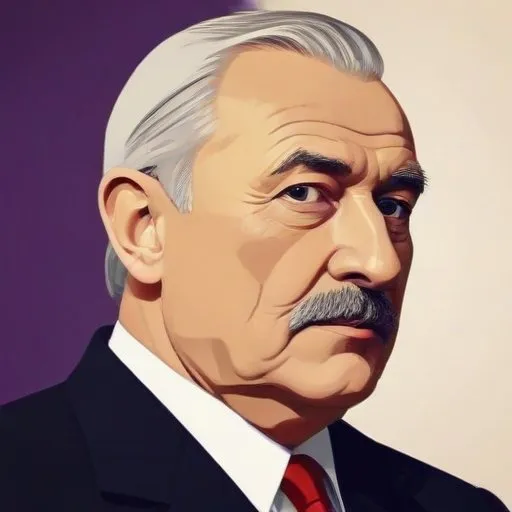
A Russian general and politician who served as Governor of Moscow Oblast, known for his military leadership during the Soviet-Afghan War and later governing the region surrounding Moscow.
Boris Gromov is a name etched in the annals of history as the last Soviet soldier to leave Afghanistan, marking the end of the Soviet-Afghan War in 1989. This distinction is a testament to his bravery and dedication as a military officer, a reputation he built over three tours of duty in the war-torn country.
Born on November 7, 1943, in Saratov, Russian SFSR, Soviet Union, Gromov's early life was marked by a strong inclination towards a military career. He graduated from a Suvorov military cadet school, followed by the Leningrad Military Commanders School, and later from the Frunze Military Academy in Moscow, and the General Staff Academy.
Gromov's military career was shaped by his experiences in Afghanistan, where he did three tours of duty from 1980 to 1989. His most notable stint was as the last Commander of the 40th Army in Afghanistan, a position that earned him the highest military award, the golden star of the Hero of the Soviet Union, after Operation Magistral lifted the siege of the city of Khost in eastern Afghanistan.
As the Soviet Union withdrew its forces from Afghanistan, Gromov was the last soldier to leave, crossing the Friendship Bridge spanning the AmuDarya river on foot on February 15, 1989. This symbolic act marked the end of the Soviet-Afghan War, a conflict that had lasted for nearly a decade.
Gromov's military career was not without controversy. During the Red Army withdrawal in February 1989, 30 to 40 military trucks crammed with Afghan historical treasures crossed into the Soviet Union, under orders from General Gromov. One of these treasures was an antique Tekke carpet stolen from Darul Aman Palace, which Gromov cut into several pieces and gave to his acquaintances.
After the Afghan War, Gromov transitioned to a career in politics. He was chosen as a candidate for vice president by the Communist Party in the Russian presidential election of 1991, running alongside former premier Nikolai Ryzhkov. He later served as First Deputy Defence Minister of the Russian Federation.
In 1994, Gromov retired from the Russian Armed Forces, marking the end of his military career. He went on to serve as the Governor of Moscow Oblast from January 2000 to May 2012, a position that allowed him to apply his leadership skills in a civilian context.
Boris Gromov's legacy is complex, marked by both bravery and controversy. However, his dedication to his country and his role in shaping the course of history cannot be denied. As the last Soviet soldier to leave Afghanistan, he will always be remembered as a symbol of the end of the Soviet-Afghan War.
Today, Gromov's name is synonymous with leadership, bravery, and a commitment to service. His story serves as a testament to the power of human resilience and the importance of honoring one's duty, even in the face of adversity.
74 Years Old
A Russian politician who has dominated the country's politics for over two decades, known for his authoritarian leadership style and controversial foreign policy decisions.
61 Years Old
Russian lawyer and politician who served as President of Russia from 2008 to 2012, known for his efforts to modernize Russia's economy and politics. He also served as Prime Minister from 2012 to 2020.
76 Years Old
Russia's top diplomat, responsible for shaping the country's foreign policy and representing its interests on the global stage, known for his sharp wit and tough negotiating style.
85 Years Old
The 37th Prime Minister of Russia, serving from 2007 to 2008, known for his brief tenure and role in Russian politics during Vladimir Putin's presidency. He's a businessman and politician with ties to the energy sector.
