


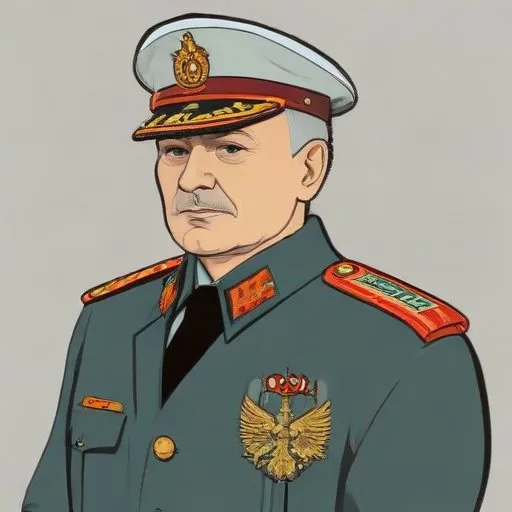
A prominent military strategist and theorist who played a crucial role in modernizing the Soviet Red Army, particularly in the development of its air force and mechanized warfare capabilities.
Boris Shaposhnikov is renowned for his groundbreaking contributions to Soviet military theory and doctrine, earning him the esteemed title of Marshal of the Soviet Union. His seminal work, "Mozg Armii" (The Brain of the Army), remains a landmark in Soviet military strategy, shaping the organization and operation of the Red Army's General Staff.
Born on October 2, 1882, in Zlatoust, Russia, Shaposhnikov hails from a family of Orenburg Cossack origins. He graduated from the Nicholas General Staff Academy in 1910 and served in the Imperial Russian Army, rising to the rank of colonel during World War I. Shaposhnikov supported the Russian Revolution and later joined the Red Army, although he didn't become a member of the Communist Party until 1939.
Shaposhnikov's expertise in military strategy propelled him to the position of Chief of the Staff of the Red Army in 1928, a role he held until 1931. During this period, he played a pivotal role in shaping the Soviet military's organizational structure and operational doctrine. He then went on to serve as commandant of the Frunze Military Academy, further solidifying his reputation as a leading military theorist.
In 1937, Shaposhnikov was appointed to the newly created position of Chief of the General Staff, a role that cemented his status as a key advisor to Stalin. His tenure was marked by significant reforms, including the modernization of the Soviet military and the development of innovative tactics. Despite his success, Shaposhnikov was forced to resign in 1940 following Soviet failures during the Winter War in Finland.
Shaposhnikov's expertise was again called upon during World War II, and he was reappointed as Chief of the General Staff in 1941, replacing Georgy Zhukov. Although he was forced to resign a year later due to declining health, Shaposhnikov continued to serve as an influential advisor to Stalin, playing a crucial role in shaping Soviet military strategy until his death in 1945.
Shaposhnikov's contributions to Soviet military theory and doctrine have had a lasting impact on modern military strategy. His work, "Mozg Armii," remains a seminal text, and his influence can be seen in the development of military organizations around the world. As a renowned military theorist and strategist, Shaposhnikov's legacy continues to inspire military leaders and scholars alike.
Through his remarkable career and groundbreaking contributions, Boris Shaposhnikov has left an indelible mark on the Soviet military and modern military strategy, cementing his status as one of the most influential military theorists of the 20th century.
Born in 1896
A Soviet military leader who played a crucial role in defeating Nazi Germany in World War II, and later became a key figure in Soviet politics.
Born in 1896
A Soviet military leader who played a crucial role in several key battles, including the Battle of Stalingrad and the capture of Berlin, earning him the highest military honors. He was a skilled strategist and tactician who helped turn the tide of the war in favor of the Allies.
Born in 1897
A Soviet military leader who played a crucial role in the Eastern Front of World War II, leading the Red Army to several key victories.
