


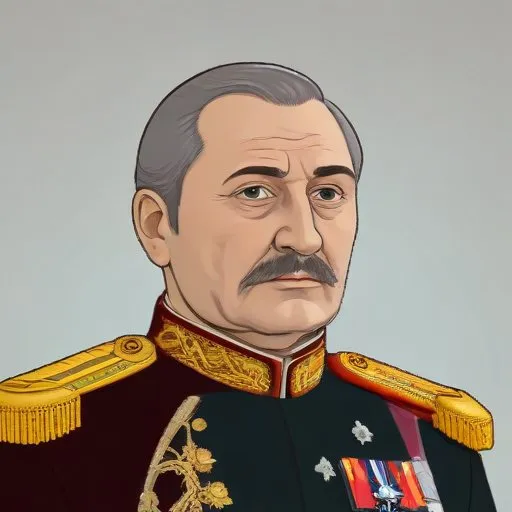
A Soviet military leader who played a crucial role in the Eastern Front of World War II, leading the Red Army to several key victories.
Ivan Khristoforovich Bagramyan, a Marshal of the Soviet Union, was a distinguished Soviet military commander of Armenian origin who played a crucial role in the Soviet counteroffensives against Nazi Germany during World War II. He was the second non-Slavic military officer to become a commander of a Front, a testament to his exceptional military prowess.
Ivan Bagramyan was born on December 2, 1897, in Yelisavetpol, Azerbaijan, to Armenian parents. His family hailed from the village of Chardakhlu, which was part of the Russian Empire. Growing up in a family of modest means, Bagramyan's parents instilled in him the importance of education, which would later become a cornerstone of his military career.
Bagramyan's military journey began in 1915 when he joined the Imperial Russian Army. He saw combat during World War I and later joined the Red Army during the Russian Civil War. After the war, he attended the Leningrad Cavalry School and later the Frunze Military Academy, where he honed his military skills and developed a keen understanding of military strategy.
Bagramyan's experience in military planning as a chief of staff allowed him to distinguish himself as a capable commander in the early stages of the Soviet counteroffensives against Nazi Germany. In 1942, he was given his first command of a unit, and in November 1943, he received his most prestigious command as the commander of the 1st Baltic Front.
As commander of the Baltic Front, Bagramyan participated in several offensives that pushed German forces out of the Baltic republics. His military acumen and strategic thinking played a significant role in the Soviet Union's ultimate victory over Nazi Germany.
Bagramyan's contributions to the Soviet war effort did not go unrecognized. He was awarded numerous honors, including the title of Hero of the Soviet Union, which he received twice, in 1944 and 1945. He was also awarded the Order of Lenin, the Order of the October Revolution, and the Order of Suvorov, among others.
After the war, Bagramyan served as a deputy of the Supreme Soviets of the Latvian Soviet Socialist Republic and Armenian Soviet Socialist Republic. He was a regular attendee of the Party Congresses and, in 1952, became a candidate for entry into the Central Committee. In 1961, he was inducted as a full member of the Central Committee.
Bagramyan's legacy as a national hero continues to be celebrated in Armenia and the Soviet Union. He remains one of the most esteemed military commanders in Soviet history, and his contributions to the Soviet war effort are still studied by military historians and strategists today.
Despite his rise to prominence, Bagramyan remained humble and grounded. He was known for his simplicity and modesty, qualities that earned him the respect and admiration of his peers and subordinates alike.
Bagramyan's philosophy was centered around the importance of education, hard work, and loyalty. He believed that these values were essential for personal and professional growth, and he instilled them in his soldiers and colleagues throughout his military career.
Ivan Bagramyan's remarkable military career and legacy serve as a testament to his exceptional leadership skills, strategic thinking, and unwavering commitment to his country. As a Soviet military commander, he played a crucial role in the Soviet Union's victory over Nazi Germany, and his contributions continue to inspire generations of military leaders and historians today.
Born in 1878
The Soviet Union's ruthless leader who ruled with an iron fist, implementing policies that led to widespread famine and purges, while also playing a crucial role in defeating Nazi Germany in World War II.
Born in 1896
A Soviet military leader who played a crucial role in defeating Nazi Germany in World War II, and later became a key figure in Soviet politics.
Born in 1899
Soviet Union's ruthless secret police chief, responsible for millions of deaths and brutal suppressions during Stalin's regime, known for his cunning and feared reputation.
Born in 1896
A Soviet military leader who played a crucial role in several key battles, including the Battle of Stalingrad and the capture of Berlin, earning him the highest military honors. He was a skilled strategist and tactician who helped turn the tide of the war in favor of the Allies.
Born in 1881
A Soviet politician and military leader who served as Defense Minister during World War II, playing a crucial role in the Soviet war effort and later becoming a key figure in Stalin's government. He's also known for his iconic tank, the KV-1, named in his honor.
