


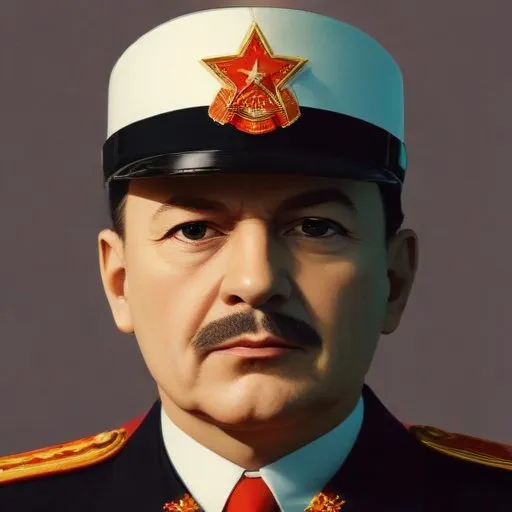
A Soviet politician and military leader who served as Defense Minister during World War II, playing a crucial role in the Soviet war effort and later becoming a key figure in Stalin's government. He's also known for his iconic tank, the KV-1, named in his honor.
Kliment Voroshilov was a prominent Soviet military officer and politician who played a crucial role in the Stalin era. He is best known for being one of the original five Marshals of the Soviet Union and serving as the Chairman of the Presidium of the Supreme Soviet, the nominal head of state, from 1953 to 1960.
Born on February 4, 1881, in Ukraine, Voroshilov came from a Russian worker's family. He became an early member of the Bolsheviks and took part in the Russian Revolution of 1917. During the revolution, he served with distinction at the Battle of Tsaritsyn, where he became a close friend of Joseph Stalin.
In 1921, Voroshilov was elected to the Central Committee of the Communist Party, and in 1925, Stalin appointed him People's Commissar for Military and Navy Affairs, later becoming People's Commissar for Defence. In 1926, he became a full member of the Politburo, solidifying his position as a key player in the Soviet government.
In 1935, Voroshilov was named a Marshal of the Soviet Union, the second-highest military rank in the Soviet Union. However, at the outbreak of World War II, he was held responsible for Soviet failures in Finland during the Winter War and was replaced as Defense Commissar by Semyon Timoshenko.
Following the German invasion in June 1941, Voroshilov was recalled and appointed to the State Defense Committee. Despite his efforts, he failed to stop the German encirclement of Leningrad and was again relieved from his command in September 1941.
After the war, Voroshilov oversaw the establishment of a socialist regime in Hungary. Following Stalin's death in 1953, Voroshilov was appointed Chairman of the Presidium of the Supreme Soviet, becoming the nominal head of state.
However, his fortunes declined during the rise of Nikita Khrushchev, and the Supreme Soviet turned against him. He peacefully resigned in 1960 and lived a quiet life until his death on December 2, 1969.
Voroshilov's legacy is complex and multifaceted. While he played a significant role in shaping the Soviet military and politics, his failures during World War II and his role in suppressing dissident voices have been criticized by historians.
Despite this, Voroshilov remains an important figure in Soviet history, and his contributions to the establishment of socialist regimes in Eastern Europe continue to be studied by scholars today.
"The Soviet Union is a socialist state, and our task is to build socialism and communism." — Kliment Voroshilov
Voroshilov's life and career were deeply embedded in the Soviet system, and his legacy reflects the complexities and contradictions of the Stalin era. Despite his flaws and mistakes, he remains an important figure in Soviet history, and his contributions to the development of socialism continue to be studied and debated by scholars today.
As a family travel blogger, I believe that understanding historical figures like Voroshilov is essential for our children to appreciate the complexities of the world we live in. By exploring the lives and legacies of those who shaped our world, we can inspire our kids to become curious learners and empathetic global citizens.
Born in 1878
The Soviet Union's ruthless leader who ruled with an iron fist, implementing policies that led to widespread famine and purges, while also playing a crucial role in defeating Nazi Germany in World War II.
Born in 1890
A Soviet Minister of Foreign Affairs who played a crucial role in shaping the country's foreign policy during World War II and the early Cold War era, known for his diplomatic skills and signature cocktails.
Born in 1899
Soviet Union's ruthless secret police chief, responsible for millions of deaths and brutal suppressions during Stalin's regime, known for his cunning and feared reputation.
Born in 1896
A Soviet military leader who played a crucial role in defeating Nazi Germany in World War II, and later became a key figure in Soviet politics.
Born in 1895
Soviet politician who served as Premier of the Soviet Union during the Khrushchev era, known for his role in implementing economic reforms and reducing Stalin-era repression.
Born in 1894
The Soviet leader who initiated reforms and denounced Stalin's regime, known for his bold policies and iconic shoe-banging incident at the UN.
Born in 1879
Founded the Red Army and played a crucial role in the Russian Revolution, shaping the course of modern communism. A key figure in 20th-century politics and ideology.
Born in 1909
Soviet Minister of Foreign Affairs who played a crucial role in shaping the country's foreign policy during the Cold War, known for his diplomatic skills and ability to navigate complex international relations.
