


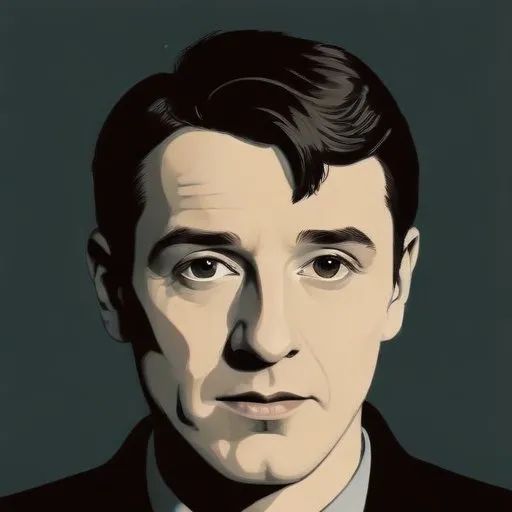
A pioneering Irish writer and satirist, best known for his humorous and subversive novels and plays that cleverly critiqued Irish politics and society.
Brian O'Nolan, better known by his pen name Flann O'Brien, is renowned for his scathingly witty and subversive literary works that challenged the social and political norms of his time. As a novelist, playwright, and journalist, O'Nolan's writing career was marked by a rebellious spirit and an unwavering commitment to satire, earning him a reputation as one of Ireland's most innovative and provocative writers.
Born in 1911 in Strabane, County Tyrone, Ireland, O'Nolan grew up in a family of 11 children. His early life was marked by a strong sense of Irish identity and a fierce criticism of the Irish establishment. After studying at University College Dublin, O'Nolan began his writing career as a columnist for the
O'Nolan's most famous work, At Swim-Two-Birds, published in 1939, is a novel that defies categorization. This wildly inventive and experimental work of fiction is a scathing critique of Irish nationalism, Catholicism, and the myth of Irish identity. Through its complex narrative structure and multiple narratives, At Swim-Two-Birds is a pioneering work of postmodern literature that has influenced generations of writers.
O'Nolan's writing career was marked by a steady stream of provocative and innovative works. His plays, such as The Hostage (1958) and Faustus Kelly (1943), challenged the conventions of Irish theatre and earned him both critical acclaim and public controversy. As a journalist, O'Nolan's columns and editorials were notorious for their biting satire and ridicule of Irish politics and society.
O'Nolan's writing was deeply influenced by his philosophical views, which were shaped by his interest in existentialism, anarchism, and socialism. His work often explores themes of individual freedom, rebellion against authority, and the search for meaning in a chaotic world. Through his writing, O'Nolan challenged the dominant ideologies of his time, advocating for a more egalitarian and libertarian society.
O'Nolan's work has had a profound influence on modern Irish literature and beyond. His innovative style and rebellious spirit have inspired generations of writers, including Samuel Beckett, James Joyce, and Thomas Pynchon. Today, O'Nolan's work remains a powerful critique of authority and a testament to the enduring power of satire and subversion.
In the words of O'Nolan himself, "Life is a tragicomedy, and the best way to face it is with a sense of humor and a rebellious heart."
Born in 1882
A pioneering modernist writer, known for experimental novels and short stories that explore the human experience, particularly in Dublin, Ireland. His works are celebrated for their complex, lyrical prose and innovative narrative structures.
Born in 1906
A pioneering absurdist writer who crafted avant-garde novels, poems, and plays that probed the human condition, often with dark humor and existential themes. His works are renowned for their complexity and influence on modern literature.
Born in 1865
A renowned Irish wordsmith and dramatist, celebrated for his mystical and nationalistic verse that explores the human condition, as well as his contributions to the Irish Literary Revival.
Born in 1854
A witty and flamboyant literary mastermind, renowned for crafting clever, humorous, and poignant works that continue to delight audiences with their clever wordplay and societal commentary.
Born in 1667
A witty wordsmith who penned scathing social commentaries, including the iconic "Gulliver's Travels", which continue to delight and provoke readers to this day.
Born in 1880
Irish playwright and memoirist known for his powerful, realistic portrayals of Dublin's working-class life, particularly during the Irish War of Independence. His plays often blended humor and tragedy, offering a unique perspective on Irish identity.
