


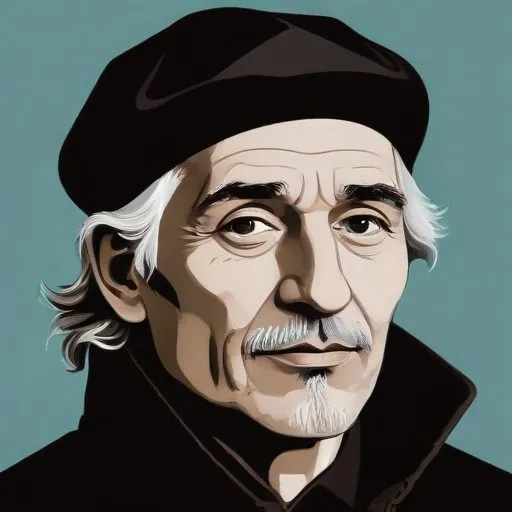
A Polish poet and author who wrote influential works of science fiction and futurism, exploring the intersection of technology and humanity. His writings predicted the rise of totalitarian regimes and the dangers of unchecked technological progress.
Bruno Jasieski, born Wiktor Bruno Zysman, was a multifaceted Polish poet, novelist, playwright, and leader of the Polish Futurist movement in the interwar period. He is renowned for his pioneering work in introducing Futurism to Poland, as well as his commitment to communist activism in Poland, France, and the Soviet Union.
Wiktor Bruno Zysman was born on July 17, 1901, in Klimontów, Congress Poland, to a family of Jewish origin. His mother, Eufemia Maria née Modzelewska, came from a Catholic Polish szlachta nobility family. Jasieski's father, Jakub Zysman, was a prominent local doctor and social worker, active in Klimontów intelligentsia. The family's relocation to Russia in 1914, during World War I, exposed Jasieski to the works of Igor Severyanin, Velimir Chlebnikov, Vladimir Mayakovsky, and Alexei Kruchonykh, sparking his fascination with Futurism.
In 1918, Jasieski arrived in Kraków, where he attended courses in Polish literature, law, and philosophy at the Jagiellonian University. He became active in avant-garde circles and co-founded the Katarynka (Barrel Organ) club, a gathering of Futurists that aimed to identify with the common people and promote anti-elitism.
Jasieski's literary pursuits flourished in Kraków, Warsaw, and other parts of Poland, where he collaborated with notable figures such as Stanisław Młodożeńiec and Tytus Czyżewski. His work was characterized by its revolutionary tone, condemning the traditional and embracing the modern and avant-garde.
In the 1920s, Jasieski's political activism intensified, and he became involved with the Communist Party of Poland. He later moved to France, where he continued his political activities, before eventually relocating to the Soviet Union. Unfortunately, during the Great Purge of 1937-1938, Jasieski was arrested and executed on September 17, 1938, at the age of 37.
Despite his tragic fate, Jasieski's contributions to Polish literature and Futurism are still celebrated today. He is hailed as a patron by members of various modernist art groups. An annual literary festival, Brunonalia, is held in his birthplace, Klimontów, Poland, where one of the streets is named after him.
Bruno Jasieski's remarkable life, marked by his relentless pursuit of artistic innovation and political conviction, continues to inspire and fascinate scholars, artists, and readers alike.
Born in 1894
A renowned Polish literary figure, celebrated for his innovative and humorous poetry, plays, and theatrical direction, which continue to inspire and entertain audiences.
Born in 1869
A Polish Renaissance man who excelled in poetry, playwriting, and painting, creating iconic works that merged folk motifs with modernist styles. His innovative art and literature continue to inspire Polish culture.
Born in 1878
A Ukrainian-Polish poet and academic who made significant contributions to 20th-century Polish literature, exploring themes of existentialism and modernity. Their work is characterized by its lyricism and philosophical depth.
