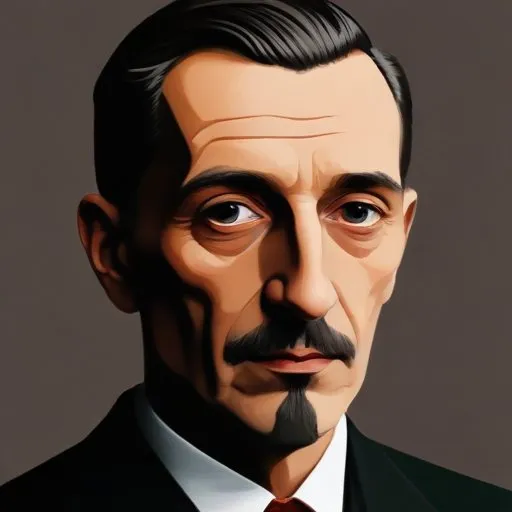
Bruno Schulz: The Enigmatic Polish-Jewish Writer and Artist
A Master of Prose and Paint
Bruno Schulz was a Polish-Jewish writer, fine artist, literary critic, and art teacher, regarded as one of the great Polish-language prose stylists of the 20th century. He is known for his unique and imaginative storytelling, which often blurred the lines between fantasy and reality, and his vivid, dreamlike paintings that captured the essence of his hometown, Drohobych.
A Life of Dualities
Born on July 12, 1892, in Drohobych, Austrian Galicia (now part of Ukraine), Schulz was the son of a cloth merchant, Jakub Schulz, and Henrietta née Kuhmerker. He grew up in a town where Polish, Ukrainian, and Jewish cultures intertwined, influencing his work and worldview. Schulz developed an interest in the arts at a very early age, and his early education at Wadysław Jagiełło Middle School in Drohobych laid the foundation for his future successes.
Awards and Recognition
In 1938, Schulz received the prestigious Golden Laurel award from the Polish Academy of Literature, solidifying his position as a leading literary figure in Poland. His work was widely acclaimed, and he was recognized as a master of his craft, alongside other prominent writers of his time.
Teaching and Writing
Schulz's teaching career spanned over 15 years, during which he taught crafts and drawing at Wadysław Jagiełło Middle School. Although he disliked teaching, he maintained his job as it was his sole source of income. However, this did not deter him from pursuing his passion for writing. He would often regale his students with stories during classes, nurturing his imagination and developing his unique narrative style.
The Tragic Loss of Genius
Tragically, Schulz's life was cut short on November 19, 1942, when he was shot and killed by a Gestapo officer while walking back home with a loaf of bread in the Drohobych Ghetto. His death marked the loss of a brilliant writer and artist, whose works were not only a reflection of his own experiences but also a testament to the rich cultural heritage of his hometown.
Legacy and Influence
Despite the loss of several of his works during the Holocaust, including his final, unfinished novel, "The Messiah," Schulz's legacy continues to inspire generations of writers, artists, and readers. His unique blend of Eastern European folklore, mythology, and modernist experimentation has influenced many writers, including
Cynthia Ozick, who has often spoken about the profound impact of Schulz's work on her own writing.
Personal Milestones and Controversies
- Schulz's early studies were interrupted by illness, which forced him to take a two-year break from his education.
- He briefly studied architecture in Vienna in 1917, which further fueled his imagination and creativity.
- Schulz's Jewish heritage and Polish upbringing often led to controversy and debate about his identity, which he navigated with remarkable sensitivity and nuance.
Quotes and Memorable Sayings
"The city is a body, and I am one of its cells."
"The truth is not always beautiful, nor beautiful words the truth."
Visual Timelines and Milestones
| 1892 |
Bruno Schulz born in Drohobych, Austrian Galicia (now Ukraine) |
| 1902-1910 |
Attends Wadysław Jagiełło Middle School in Drohobych |
| 1913 |
Resumes studies in architecture at Lviv Polytechnic |
| 1917 |
Briefly studies architecture in Vienna |
| 1924-1941 |
Teaches crafts and drawing at Wadysław Jagiełło Middle School |
| 1938 |
Awarded the Golden Laurel by the Polish Academy of Literature |
| 1942 |
Killed by a Gestapo officer in the Drohobych Ghetto |
By exploring the life and works of Bruno Schulz, we gain a deeper understanding of the complex cultural tapestry of Eastern Europe and the profound impact of his imagination on modern literature.
FAQ
What is Bruno Schulzs style in literature?
Bruno Schulz was a Ukrainian-Polish author and painter, known for his surreal, fantastical, and often dreamlike stories, which blended elements of mythology, folklore, and psychological insight.
What are Bruno Schulzs most famous works?
Bruno Schulz is famous for his short story collections, including Cinnamon Shops (1934) and Sanatorium Under the Sign of the Hourglass (1937).
How did Bruno Schulzs life influence his writing?
Bruno Schulzs life in Drohobych, Ukraine, and his experiences during World War II, including his time in the Lvov Ghetto, deeply influenced his writing, which often explored themes of identity, culture, and the human condition.
What was Bruno Schulzs relationship with the literary world?
Bruno Schulz was a recluse, who maintained a distance from the literary establishment, but was admired by his contemporaries, including Witold Gombrowicz and Czesław Miłosz.
What is Bruno Schulzs legacy in literature?
Bruno Schulz is celebrated as a unique and innovative writer, whose work continues to inspire and influence writers, artists, and thinkers around the world.