


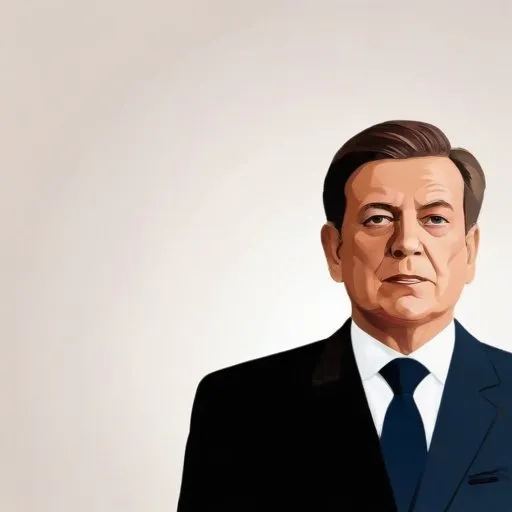
A Brazilian journalist, lawyer, and politician who served as the 18th President of Brazil, known for his progressive reforms and efforts to modernize the country. He played a significant role in shaping Brazil's political landscape during the 1950s.
Caf Filho, a Brazilian politician, is best known for serving as the 18th president of Brazil, taking office after the sudden suicide of President Getúlio Vargas in 1954. As the first Protestant to occupy the position, Filho's presidency was marked by controversy, reform, and a commitment to constitutional liberties.
Born on February 3, 1899, in Natal, Rio Grande do Norte, Filho began his career as a journalist, founding the Jornal do Norte in 1921. He later edited the O Correio de Bezerros in Pernambuco and directed the newspaper A Noite, where he penned articles that called on soldiers to refuse to fight against the Coluna Prestes, a rebellious military movement. This act of defiance led to his conviction and subsequent imprisonment for three months.
Despite his early setbacks, Filho's political career flourished. He joined the Liberal Alliance and helped found the Social Nationalist Party of Rio Grande do Norte (PSN) in 1933. He was elected as a federal deputy from 1935 to 1937, during which time he advocated for constitutional liberties. When threatened with arrest, he sought asylum in Argentina, returning to Brazil in 1938.
Filho co-founded the Progressive Republican Party (PRP) with Ademar de Barros, and was re-elected as a federal deputy from 1946 to 1950. He eventually became vice president, where he also served as president of the Senate, before ascending to the presidency following Vargas' death.
As president, Filho appointed economist Eugenio Gudin as minister of finance, who implemented orthodox economic policies to stabilize the economy and combat inflation. Filho's presidency was marked by controversy, particularly surrounding the investigation into Vargas' death, which led to the resignation of several government officials.
Despite the challenges, Filho's government implemented several reforms, including the creation of the National Housing Bank, the National Economic Development Bank, and the Brazilian Institute of Geography and Statistics. He also promoted the development of the country's infrastructure, particularly in the areas of energy and transportation.
Filho's presidency, although marked by controversy, played a significant role in shaping Brazil's political landscape. His commitment to constitutional liberties and economic reforms helped stabilize the country's economy and paved the way for future generations of politicians. As the first Protestant to occupy the presidency, Filho's tenure also marked a significant milestone in Brazilian history.
Born in 1918
A Brazilian lawyer and politician who served as the 24th President of Brazil, known for his left-wing policies and nationalization of industries, leading to a military coup that ousted him.
Born in 1882
A dominant leader who ruled Brazil from 1930 to 1945 and again from 1951 until his suicide in 1954, known for implementing reforms and promoting nationalism.
Born in 1917
A Brazilian lawyer and politician who served as the 22nd President of Brazil, known for his populist and nationalist policies, as well as his unexpected resignation after only seven months in office.
Born in 1910
A Brazilian lawyer and politician who served as Prime Minister of Brazil, known for being the first civilian to assume the office after a long period of military rule. He's also famous for dying before taking office, sparking a national crisis.
Born in 1883
A Brazilian military leader who served as president from 1946 to 1951, known for his role in rebuilding the country after World War II. He implemented various reforms and modernized the country's infrastructure.
