


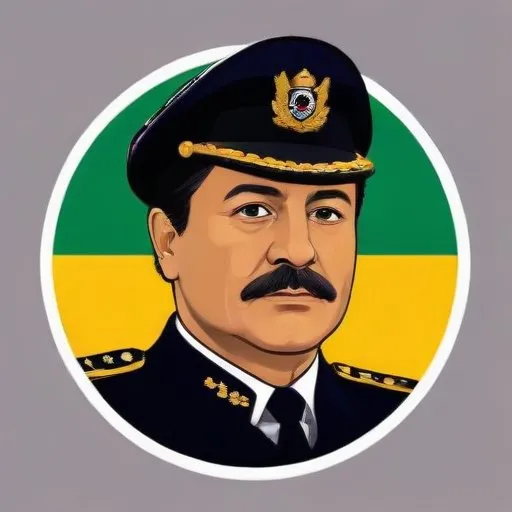
A Brazilian military leader who served as president from 1946 to 1951, known for his role in rebuilding the country after World War II. He implemented various reforms and modernized the country's infrastructure.
Eurico Gaspar Dutra, a Brazilian military leader and politician, is best known for his presidency from 1946 to 1951, marking the beginning of the Fourth Brazilian Republic. As the first president of this era, Dutra played a crucial role in shaping the country's politics and economy, earning him a place in Brazilian history.
Born on May 18, 1883, in Cuiabá, Mato Grosso, Dutra's path to presidency was paved by his military career. He studied at the Preparatory and Tactical School of Rio Grande do Sul and later at the Military Academy of Brazil, where he was expelled for participating in the Vaccine Revolt, only to be pardoned and return to complete his course.
Dutra's military career was marked by his involvement in several key events, including the repression of the São Paulo Revolution of 1924 and the fighting against an insurgency in Manaus. He co-founded the National Defense magazine in 1918 and graduated as the top of his class from the School of General Staff, earning the rare mention "très bien" in 1922.
Dutra's military background and involvement in various political events laid the foundation for his presidential campaign. He was elected as the 16th President of Brazil in 1946, marking the beginning of the Fourth Brazilian Republic. His presidency was characterized by his efforts to institutionalize democracy, promote economic growth, and improve social welfare.
During his presidency, Dutra implemented several key policies, including the creation of the National Bank for Economic Development (BNDE) and the establishment of the Ministry of Labor, Industry, and Commerce. He also played a crucial role in shaping Brazil's foreign policy, particularly in relation to the United States.
Eurico Gaspar Dutra's presidency had a lasting impact on Brazilian politics and economy. His commitment to democracy and institutionalization helped to consolidate the country's Fourth Republic. His economic policies, although sometimes criticized, laid the foundation for Brazil's future economic growth.
Dutra's legacy extends beyond his presidency. He played a key role in shaping Brazil's military and political landscape, leaving behind a legacy of service and dedication to his country.
Dutra's personal life was marked by his strong sense of duty and commitment to his country. He was known for his simplicity and humility, often preferring to focus on his work rather than his personal life.
Some of Dutra's notable personal milestones include:
Dutra's presidency was marked by his unique leadership style, which set him apart from his contemporaries. While some critics have compared him to Getúlio Vargas, another prominent Brazilian leader, Dutra's presidency was distinct in its focus on institutionalization and economic growth.
Despite facing opposition from various quarters, Dutra remains an important figure in Brazilian history, remembered for his commitment to democracy and his role in shaping the country's political and economic landscape.
Born in 1882
A dominant leader who ruled Brazil from 1930 to 1945 and again from 1951 until his suicide in 1954, known for implementing reforms and promoting nationalism.
Born in 1917
A Brazilian lawyer and politician who served as the 22nd President of Brazil, known for his populist and nationalist policies, as well as his unexpected resignation after only seven months in office.
Born in 1918
A Brazilian lawyer and politician who served as the 24th President of Brazil, known for his left-wing policies and nationalization of industries, leading to a military coup that ousted him.
Born in 1907
Brazil's 29th President, a military leader who ruled with an iron fist, implementing economic reforms and gradually democratizing the country. He's remembered for his authoritarian yet modernizing governance.
Born in 1918
The 30th President of Brazil, a military leader who ruled from 1979 to 1985, is known for his role in transitioning the country from a military dictatorship to democracy. He implemented amnesty for political prisoners and allowed exiles to return.
