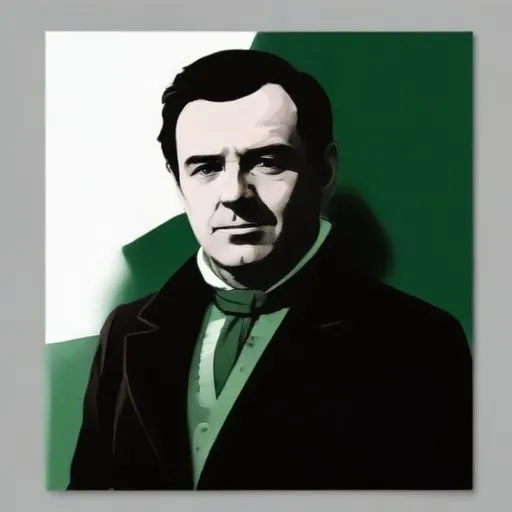
Cahir Healy: The Unwavering Anti-Partitionist
A Champion of Irish Nationalism
Cahir Healy, a prominent Irish politician, is renowned for his resolute opposition to the partition of Ireland, particularly the inclusion of County Fermanagh and County Tyrone into Northern Ireland. As a founder member of the Irish Republican organization Sinn Féin in 1905, Healy dedicated his life to the pursuit of Irish nationalism and unity.
Early Life and Journalism
Born on 2 December 1877 in Mountcharles, County Donegal, Ireland, Healy began his career as a journalist, working on various local papers. This experience laid the foundation for his later involvement in politics, where he would eloquently express his views and ideals.
The Anti-Partitionist Movement
Healy's commitment to Irish nationalism was evident in his fervent opposition to the partition of Ireland. In 1921, he was part of a Fermanagh nationalist delegation that met with President Éamon de Valera, emphasizing their determination to resist the establishment of a Northern Irish Parliament. Healy firmly believed that County Fermanagh and County Tyrone, with their Irish nationalist majorities, should not be forced into Northern Ireland.
Persecution and Perseverance
Following the assassination of William J. Twaddell, a Unionist Member of Parliament in Belfast, Healy was interned for eighteen months on the prison ship HMS Argenta, along with 300 others, in 1922. Despite the brutal conditions, Healy remained resolute in his convictions, stating, "All my life, I have been a man of peace. It is not, therefore, because they feared that I would disturb the peace of Northern Ireland that they dragged me away from my wife and family, but for political reasons."
Legacy and Impact
Healy's tireless efforts contributed significantly to the Irish nationalist movement. His unwavering dedication to the cause inspired generations of Irish republicans. Although he faced persecution and imprisonment, Healy's resolve remained unbroken, earning him a revered place in Irish history.
Personal Milestones and Quotes
- Member of Michael Collins' special Advisory Committee on the North-East in 1922
- "I have been engaged in preparing the case for the inclusion of these areas (Fermanagh and Tyrone) in the Free State."
Historical Context and Legacy
Healy's life and struggles are a testament to the complexities of Irish history and the enduring spirit of Irish nationalism. His legacy serves as a reminder of the sacrifices made by those who fought for Irish unity and independence.
Cahir Healy's remarkable story is a powerful inspiration to anyone who has ever dared to challenge the status quo. His unwavering commitment to Irish nationalism continues to inspire generations, cementing his place as one of Ireland's most revered politicians.
FAQ
What was Cahir Healys role in the Irish independence movement?
Cahir Healy was a prominent figure in the Irish independence movement, particularly in Northern Ireland. He was a strong advocate for Irish unity and opposed partition.
What were Cahir Healys views on partition?
Cahir Healy was strongly opposed to partition, which he saw as an artificial division of the Irish people. He believed that Ireland should be a united and independent country.
What was Cahir Healys relationship with other Irish nationalists?
Cahir Healy was friends with other prominent Irish nationalists, including Éamon de Valera and Michael Collins. He worked closely with them to promote Irish independence.
How did Cahir Healys writing reflect his political views?
Cahir Healys writing reflected his strong commitment to Irish nationalism and his opposition to partition. He wrote extensively on Irish politics and history, and his work continues to be studied by scholars today.
What was Cahir Healys legacy in modern Ireland?
Cahir Healys legacy in modern Ireland is that of a committed nationalist who fought for Irish unity and independence. He is remembered as a strong advocate for Irish sovereignty and self-determination.