


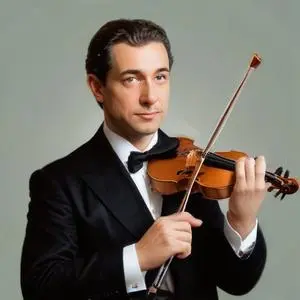
A renowned violinist and educator who developed a influential teaching method and wrote several books on violin technique, leaving a lasting impact on classical music education.
Carl Flesch, born Károly Flesch, was a Hungarian classical violinist and teacher renowned for his comprehensive Scale System, a staple of violin pedagogy that has shaped the art of violin playing. As a performer, Flesch was celebrated for his solo performances in a wide range of repertoire, from Baroque music to contemporary, and his fervent advocacy for the violinist as an artist rather than merely a virtuoso.
Flesch was born on October 9, 1873, in Moson, Hungary (now part of Mosonmagyaróvár). At the age of seven, he began playing the violin, and by 10, he was taken to Vienna to study with Jakob Grün. Flesch's talent and dedication led him to the Conservatoire de Paris, where he studied with Martin Pierre Marsick at just 17 years old.
Flesch's teaching career spanned several decades and cities, including Bucharest (1897-1902), Amsterdam (1903-1908), Philadelphia (1924-1928), and Berlin (1929-1934), where he taught at the Hochschule für Musik. His instructional books, particularly Die Kunst des Violin-Spiels (The Art of Violin Playing, 1923), solidified his reputation as a master pedagogue. Flesch's most notable pupils include Charles Barkel, Edwin Blanger, Norbert Brainin, Felix Galimir, Bronisław Gimpel, Ivry Gitlis, Szymon Goldberg, Ida Haendel, and Henryk Szeryng, among many others.
Flesch's teaching philosophy emphasized the importance of developing the violinist as an artist, rather than solely focusing on technical virtuosity. He believed that a true artist should possess a deep understanding of the music, as well as the technical skill to convey it. This approach has influenced generations of violinists and continues to shape violin pedagogy to this day.
Flesch's impact on modern violin playing is immeasurable. His students, many of whom went on to become renowned performers and pedagogues, have perpetuated his teachings and philosophies. The Scale System, in particular, remains an essential tool for violinists worldwide. Flesch's legacy serves as a testament to the transformative power of dedicated teaching and the pursuit of artistic excellence.
In his memoirs, Flesch wrote, "There was above all Henry [i.e., Henri Temianka], who did great credit to the Curtis Institute both musically and technically; he possessed a model collection of talents."
Born in 1901
A virtuosic violinist renowned for his technical perfection, tone, and phrasing, revolutionizing the art of violin playing through his recordings and teaching.
Born in 1908
A renowned violinist and educator, known for his technical mastery and emotional depth, influencing generations of musicians with his iconic performances and pedagogical legacy.
Born in 1916
A renowned violinist and conductor who mesmerized audiences with his virtuosic performances and collaborations with esteemed musicians, also a passionate advocate for music education.
Born in 1904
A virtuosic violinist and composer, renowned for his technical mastery and poetic interpretations of classical music, particularly Bach's solo violin works.
80 Years Old
A world-renowned virtuoso, celebrated for mesmerizing performances and iconic recordings that have elevated the art of classical music.
Born in 1903
A renowned pianist and composer, celebrated for his virtuosic technique and powerful performances of classical music, particularly Chopin and Rachmaninoff.
Born in 1887
A renowned pianist and educator, celebrated for his poetic and expressive performances of Chopin's music, as well as his charismatic stage presence.
Born in 1899
A renowned violinist and conductor, leading the Philadelphia Orchestra for over 40 years, known for his technical precision and interpretations of Romantic-era composers.
