


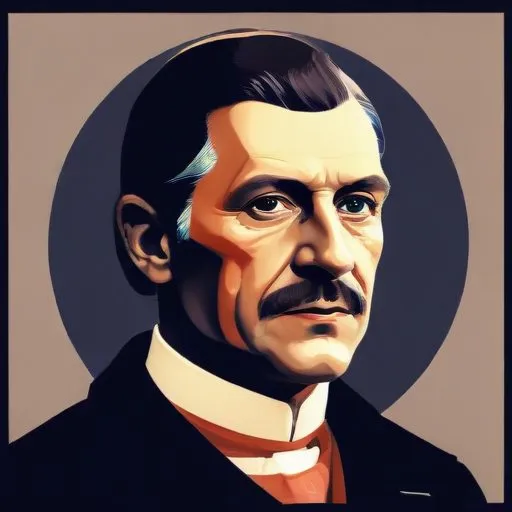
A Swedish physician and explorer who discovered the element tantalum in 1802, and led expeditions to Africa and Asia, documenting local flora and fauna.
Carl Gustaf Ekeberg was a Swedish physician, chemist, and explorer who made several voyages to the East Indies and China as a sea captain, bringing back valuable discoveries and publications that would shape the understanding of the world. He is best known for his extensive travels, expert navigation skills, and remarkable cartography, earning him a place in the Royal Swedish Academy of Sciences.
Born on June 10, 1716, in Djursholm, Uppland, Sweden, Ekeberg was the son of Gustaf Ekeberg and Catharina Ebba Fast. He pursued his studies at Uppsala University for three years (1726-1729) before becoming a pharmacy student at Västerås (1730-1736) and later a provisor in the pharmacy at Turku (1737-1738).
Trained as a pharmacist and chemist, Ekeberg started his career as a ship's doctor, eventually becoming an expert navigator. Between 1742 and 1778, he made ten trips to India and China, rising through the ranks to become a captain in 1750 for the Swedish East India Company. During his voyages, he compiled accurate maps of the coastlines along which he sailed, publishing them in his book Ostindisk Resa (1770-1771) in Stockholm (1773).
Ekeberg brought back numerous natural history specimens from his voyages, many of which he shared with his close friend and fellow scientist, Carl Linnaeus. This collaboration led to significant advancements in the field of natural history and taxonomy.
In 1744, Ekeberg married Hedvig Erlant (1719-1809). During the early 1760s, he purchased three farms, which he merged to form Altomta gård in the parish of Tensta. He died in 1784 at Altomta and was buried there.
In recognition of his contributions, Ekeberg was elected a member of the Royal Swedish Academy of Sciences in 1761 and a Fellow of the Swedish Academy of Science in Stockholm in 1777. He was also honored with the title of Knight of the Order of Vasa in 1777.
Through his remarkable voyages, publications, and contributions to science, Carl Gustaf Ekeberg left an indelible mark on the world of exploration, cartography, and natural history.
Born in 1716
A Swedish-Finnish botanist and explorer who traveled to North America in the 1740s to study its natural history, documenting new species and providing valuable insights into the region's flora and fauna.
Born in 1748
A Swedish physician and activist who traveled with Captain James Cook on his second voyage, documenting indigenous cultures and advocating for abolition of slavery.
Born in 1729
A pioneering 18th-century thinker who advocated for economic freedom, social equality, and individual liberties, laying the groundwork for modern democracy. He also championed the rights of the common people and the abolition of serfdom.
