


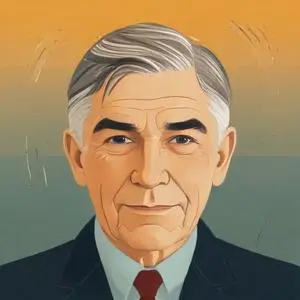
A Pulitzer Prize-winning poet and historian who celebrated the American spirit through his writing, particularly in his biography of Abraham Lincoln.
Carl Sandburg was an American poet, biographer, journalist, and editor, widely regarded as one of the most influential figures in contemporary literature. He won three Pulitzer Prizes, two for his poetry and one for his biography of Abraham Lincoln, cementing his legacy as a literary giant.
Born on January 6, 1878, in Galesburg, Illinois, Sandburg grew up in a three-room cottage with his Swedish-American parents, Clara Mathilda and August Sandberg. He adopted the nickname Charles or Charlie in elementary school, around the same time he and his siblings changed the spelling of their last name to Sandburg.
Sandburg's early life was marked by a series of odd jobs, including driving a milk wagon, working as a porter at the Union Hotel barbershop, and laboring as a bricklayer and farmhand on the wheat plains of Kansas. These experiences would later inform his writing, imbuing it with a sense of rugged individualism and a deep connection to the American heartland.
Sandburg's writing career began as a journalist for the Chicago Daily News, where he honed his skills as a storyteller and developed a keen sense of observation. He soon turned to poetry, publishing his first collection, Chicago Poems, in 1916. The book was a critical and commercial success, establishing Sandburg as a major force in American poetry.
Over the next several decades, Sandburg published numerous collections of poetry, including Cornhuskers (1918) and Smoke and Steel (1920). He also wrote biographies, novels, children's literature, and film reviews, demonstrating his boundless energy and versatility as a writer.
In 1919, Sandburg won his first Pulitzer Prize for Cornhuskers, an achievement he would repeat in 1934 for his Collected Poems. In 1940, he won his third Pulitzer Prize for his biography Abraham Lincoln: The War Years.
When Sandburg died in 1967, President Lyndon B. Johnson hailed him as "more than the voice of America, more than the poet of its strength and genius. He was America." Today, Sandburg's poetry is celebrated for its accessibility, lyricism, and profound connection to the American experience.
Sandburg's poetry is characterized by its emphasis on the common man, the beauty of everyday life, and the power of the human spirit. He believed in the importance of folk culture and the need for art to reflect the experiences of ordinary people.
Through his writing, Sandburg sought to capture the essence of American life, from the cities of the industrial north to the rural heartland. His poetry is a testament to the country's rich cultural heritage and its people's resilience and optimism.
Sandburg's impact on modern society is profound and far-reaching. His poetry has inspired generations of writers, artists, and musicians, including Bob Dylan, who has cited Sandburg as a major influence.
Today, Sandburg's legacy extends beyond the literary world to the realm of popular culture. His poetry has been set to music, adapted into films and plays, and continues to inspire new works of art and literature.
Sandburg married Lillian Steichen, sister of the famous photographer Edward Steichen, in 1908. The couple had three daughters, Margaret, Janet, and Helga, and lived on a farm in North Carolina, where Sandburg spent the later years of his life.
Sandburg's life was marked by a deep love of nature, a passion for social justice, and a commitment to his craft. He died on July 22, 1967, leaving behind a legacy of poetry, prose, and a deep connection to the American people.
"The people will live on. The learning and blunders will live on. Somewhere, sometime, a useful thing will be born of the chaos."
"A politician should have three hats. One for throwing into the ring, one for talking through, and one for pulling rabbits out of."
"I'm an idealist. I don't know where I'm going, but I'm on the way."
Sandburg's life and work spanned a tumultuous period in American history, from the rise of industrialization to the Great Depression and two World Wars. Through his poetry, he captured the hopes, fears, and aspirations of the American people, preserving a moment in time for generations to come.
Today, Sandburg's legacy extends beyond his own work to the many writers, artists, and musicians he has inspired. His poetry remains a testament to the power of art to shape our understanding of ourselves and our world.
Born in 1809
Led the United States through its Civil War and ultimately abolished slavery, leaving a lasting legacy in American history.
Born in 1819
A celebrated poet, essayist, and journalist who revolutionized American literature with his collection "Leaves of Grass", known for his free verse style and celebration of the human spirit.
Born in 1874
Pulitzer Prize-winning poet and playwright celebrated for rural New England-inspired works that explore human nature, morality, and the American experience.
Born in 1899
A legendary writer who crafted sparse, powerful prose, capturing the human experience in novels like "The Old Man and the Sea" and "A Farewell to Arms".
Born in 1896
Author of novels and short stories that capture the essence of the Jazz Age, exploring themes of wealth, class, and the American Dream. Known for timeless classics like "The Great Gatsby" and "Tender Is the Night".
Born in 1902
A renowned poet, novelist, and playwright who powerfully voiced the experiences and struggles of African Americans during the Harlem Renaissance, using jazz and blues rhythms to convey the spirit of his people.
Born in 1885
A pioneering modernist poet and critic who transformed 20th-century literature with innovative styles and provocative ideas, shaping the course of modern poetry.
Born in 1888
A renowned poet, playwright, and critic who reshaped modern poetry with works like "The Waste Land" and "Old Possum's Book of Practical Cats", influencing literature and art with their unique style.
