


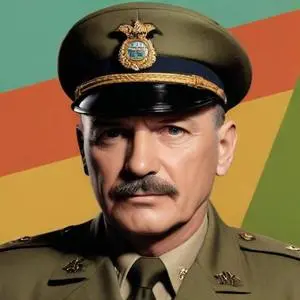
Led the US Air Forces to victory in World War II, pioneering the use of strategic bombing and playing a crucial role in shaping the US military's air power.
Carl Spaatz, nicknamed "Tooey," was a pioneering American general who revolutionized air power strategy during World War II, and later, as the first Chief of Staff of the United States Air Force, played a crucial role in shaping the country's aerial defense.
Born on June 28, 1891, in Boyertown, Pennsylvania, Spaatz grew up in a family of German ancestry. His father, Charles Busch Spatz, was a state senator and publisher of a small newspaper, The Berks County Democrat. Spaatz's early life was marked by a strong work ethic, working as a linotype operator in his father's printing shop.
Through his father's influence, Spaatz secured a West Point appointment, where he graduated as a second lieutenant of Infantry on June 12, 1914. It was during his time at West Point that he earned his nickname "Tooey," due to his resemblance to a fellow cadet, F.J. Toohey.
Spaatz's military career spanned over three decades, with early assignments in the infantry and later in the Signal Corps Aviation School. He commanded various units, including the 1st Pursuit Group, and served as the Air Officer on the staff of General Douglas MacArthur in the Philippines.
During World War II, Spaatz played a pivotal role as the commander of Strategic Air Forces in Europe, where he successfully advocated for the targeting of the enemy's oil production facilities as a priority. This strategic decision significantly contributed to the Allied victory.
In 1947, Spaatz became the first Chief of Staff of the United States Air Force, a position he held until 1948. During his tenure, he oversaw the transformation of the Air Force into a independent service branch and played a crucial role in shaping its doctrine and strategy.
Spaatz's legacy extends beyond his military accomplishments. He was a strong advocate for air power and its potential to shape modern warfare. His vision and leadership paved the way for the development of the United States Air Force into a global powerhouse.
Spaatz married Ruth Harrison in 1916, and they had three daughters together. He legally added the second "a" to his surname in 1937 to clarify the pronunciation of his name.
After retiring from the Air Force in 1948, Spaatz served as a consultant to the National Advisory Committee for Aeronautics (NACA) and later as a trustee of the Aerospace Education Foundation. He passed away on July 14, 1974, leaving behind a legacy as one of the most influential air power strategists of the 20th century.
Spaatz's remarkable career and contributions to air power have left an indelible mark on the history of military aviation. As a visionary strategist and leader, he will forever be remembered as a pioneer in the development of air power and its role in shaping modern warfare.
Born in 1890
Led the Allied forces to victory in World War II and later served as President, maintaining peace and prosperity during the Cold War era. He's known for his strategic leadership and diplomatic skills.
Born in 1885
A renowned military leader who played a crucial role in World War II, particularly in the Allied victory in Europe, known for his bold tactics and unapologetic style.
Born in 1893
Led the US Army in World War II and became the last five-star general, playing a crucial role in shaping post-war American military strategy. He's also known for his humble and unassuming leadership style.
Born in 1886
Led the United States Army Air Forces during World War II, playing a crucial role in the Allied victory, and later became the first General of the Air Force. He's also known as the "Father of the US Air Force".
Born in 1896
Led a daring bombing raid on Tokyo in 1942, earning the Medal of Honor for his bravery and helping to turn the tide of World War II.
Born in 1906
A pioneering Air Force general who played a crucial role in shaping the US military's strategic bombing capabilities during World War II and the Cold War. He's also known for his hawkish stance on communism and his influence on US foreign policy.
