


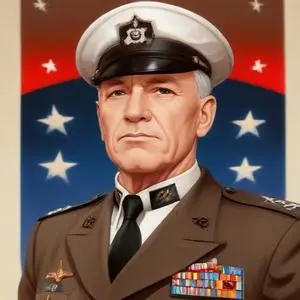
Led the United States Army Air Forces during World War II, playing a crucial role in the Allied victory, and later became the first General of the Air Force. He's also known as the "Father of the US Air Force".
Henry H. Arnold, also known as "Hap" Arnold, is widely regarded as one of the most influential figures in the history of American aviation. As a pioneering aviator, strategist, and leader, Arnold played a crucial role in shaping the course of modern air power, leaving an indelible mark on the United States military and beyond.
Born on June 25, 1886, in Gladwyne, Pennsylvania, Arnold was fascinated by flight from an early age. He graduated from the United States Military Academy at West Point in 1907 and was commissioned as a second lieutenant in the infantry. However, it wasn't until 1911 that he discovered his true calling when he learned to fly under the tutelage of the Wright brothers.
Aaronold was one of the first military pilots worldwide and one of the first three rated pilots in the history of the United States Air Force. He overcame a fear of flying that resulted from his experiences with early flight, supervised the expansion of the Air Service during World War I, and became a protégé of General Billy Mitchell. This marked the beginning of a storied career that would span over three decades.
Aaronold's star continued to rise as he assumed command of the Army Air Forces in 1941, just prior to the American entry into World War II. Under his visionary leadership, the Army Air Forces expanded from a small organization of 20,000 men and 800 first-line combat aircraft to become the largest and most powerful air force in the world.
Aaronold was a strong advocate of technological research and development. During his tenure, the Army Air Forces saw the development of the intercontinental bomber, the jet fighter, the extensive use of radar, global airlift, and atomic warfare as mainstays of modern air power.
Aaronold's legacy extends far beyond his military career. He was the founder of Project RAND, which evolved into the RAND Corporation, one of the world's largest nonprofit global policy think tanks. He was also one of the founders of Pan American World Airways, a pioneering airline that played a significant role in shaping the course of commercial aviation.
Aaronold's impact on modern society is immeasurable. He was a true visionary who recognized the potential of air power to shape the course of human history. Through his tireless efforts, he helped to create a new era of global connectivity, cooperation, and understanding.
"The thing that lies at the foundation of positive change, the way I see it, is service to a fellow human being."
Aaronold's quotes and sayings are a testament to his commitment to public service, his passion for aviation, and his dedication to shaping a better future for generations to come.
Aaronold's numerous awards and honors are a testament to his outstanding service and contributions to the field of aviation. Some of his notable awards include:
Born in 1890
Led the Allied forces to victory in World War II and later served as President, maintaining peace and prosperity during the Cold War era. He's known for his strategic leadership and diplomatic skills.
Born in 1885
A renowned military leader who played a crucial role in World War II, particularly in the Allied victory in Europe, known for his bold tactics and unapologetic style.
Born in 1880
A highly decorated war hero and master strategist who led troops to victory in World War I and II, and later became a prominent figure in the occupation of Japan.
Born in 1885
Led the U.S. Pacific Fleet to victory in World War II, playing a crucial role in defeating Japan and ending the war. He was a highly respected and decorated naval leader.
Born in 1906
A pioneering Air Force general who played a crucial role in shaping the US military's strategic bombing capabilities during World War II and the Cold War. He's also known for his hawkish stance on communism and his influence on US foreign policy.
Born in 1891
Led the US Air Forces to victory in World War II, pioneering the use of strategic bombing and playing a crucial role in shaping the US military's air power.
Born in 1896
Led a daring bombing raid on Tokyo in 1942, earning the Medal of Honor for his bravery and helping to turn the tide of World War II.
