


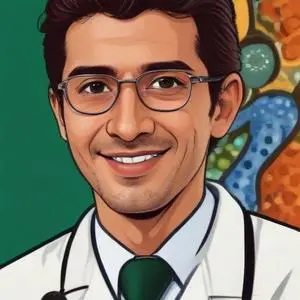
Discovered the Chagas disease and developed a treatment for it, revolutionizing the field of tropical medicine.
Carlos Chagas, a Brazilian sanitary physician, scientist, and microbiologist, is renowned for his groundbreaking discovery of Chagas disease, a protozoal infection that bears his name. This disease, also known as American trypanosomiasis, is a widespread health problem in Central and South America, and Chagas' work has been instrumental in understanding and combating this debilitating condition.
Born on July 9, 1879, in Oliveira, Minas Gerais, Brazil, Chagas was the son of a coffee farmer and a homemaker of Portuguese descent. After his father's untimely death when Chagas was just four years old, his mother enrolled him in a Jesuit boarding school in São Paulo. However, following the abolition of slavery in 1888, Chagas was forced to leave the school and continue his education at a Catholic school in San Antonio, where he completed his secondary studies.
Chagas' early academic pursuits took him to the School of Mining Engineering at Ouro Preto, but a bout of beriberi in 1895 forced him to take a break and recover in Oliveira. During his convalescence, Chagas developed an interest in medicine, which ultimately led him to pursue a degree in medicine from the University of Rio de Janeiro. Upon graduating in 1903, Chagas began his career as a clinician and researcher at the Oswaldo Cruz Institute in Rio de Janeiro.
In 1909, while working at the Oswaldo Cruz Institute, Chagas made the groundbreaking discovery of Trypanosoma cruzi, the parasite responsible for Chagas disease. He named the parasite in honor of his friend and mentor, Oswaldo Cruz. This discovery was a significant milestone in the history of medicine, as it revealed a previously unknown infectious disease, its pathogen, vector, host, clinical manifestations, and epidemiology.
In addition to his work on Chagas disease, Chagas also discovered the causative fungi of pneumocystis pneumonia, a condition that would later become infamous for its association with AIDS patients. He described the parasitic fungal genus Pneumocystis, a discovery that has had far-reaching implications for our understanding of respiratory diseases.
Chagas' contributions to medicine were recognized during his lifetime, with numerous awards and honors bestowed upon him. In 1913, he was elected as a member of the Brazilian Academy of Sciences, and in 1925, he received the Grand Cross of the Order of Scientific Merit, Brazil's highest scientific honor.
Carlos Chagas' work has left an indelible mark on the history of medicine. His discoveries have improved our understanding of infectious diseases, and his contributions to the field of microbiology have paved the way for future generations of scientists and researchers. Today, Chagas disease remains a major public health concern in Central and South America, but thanks to Chagas' pioneering work, we are closer than ever to developing effective treatments and preventing this debilitating condition.
Born in 1872
Founded the leading research institution in Brazil, revolutionizing public health and disease control in the country, and making significant contributions to the fields of bacteriology and epidemiology.
Born in 1879
Led a peasant uprising against the Mexican government, fighting for land reform and social justice, and is now a symbol of the Mexican Revolution.
Born in 1878
A legendary figure in the Mexican Revolution, he led a rebellion against the government and robbed trains, becoming a folk hero and symbol of resistance against oppression.
Born in 1908
Chile's first democratically elected Marxist president, who implemented radical socialist reforms and nationalized key industries, but was overthrown in a CIA-backed coup.
99 Years Old
The Cuban revolutionary who led the country from 1959 to 2008, implementing socialist policies and defying US opposition, becoming an iconic figure in modern history.
Born in 1895
The authoritarian leader who ruled Argentina with his charismatic wife Eva, implementing populist economic policies and promoting nationalism, while suppressing opposition and civil liberties.
Born in 1919
A former actress who used her charisma and influence to advocate for women's suffrage and workers' rights, becoming a beloved and powerful figure in Argentine politics.
Born in 1904
A Chilean poet and diplomat who wrote passionate and evocative poetry that explored love, politics, and the human condition, and was awarded the Nobel Prize in Literature in 1971.
