


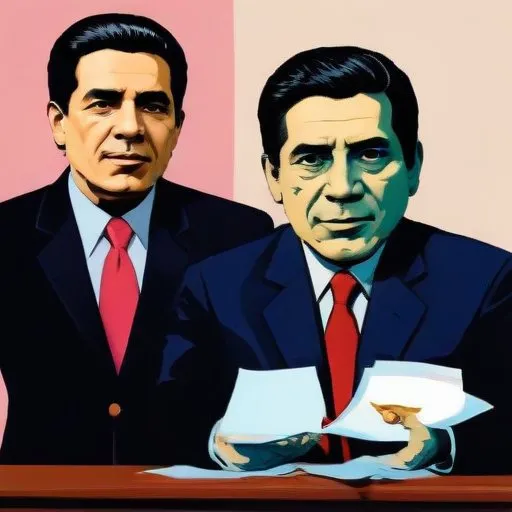
A Honduran lawyer and politician who served as President of Honduras from 1994 to 1998, known for his efforts to reform the country's economy and reduce poverty. He also played a key role in resolving the country's border disputes with El Salvador.
Carlos Roberto Reina, a renowned Honduran politician, lawyer, and diplomat, is best known for his unwavering commitment to promoting human rights and democracy in Honduras. As the President of Honduras from 1994 to 1998, Reina played a pivotal role in shaping the country's political landscape, fighting against military dictatorships, and advocating for social justice.
Born on March 13, 1926, in Comayagüela, Honduras, Reina grew up in a society plagued by political turmoil and social inequality. He pursued his higher education at the National Autonomous University of Honduras, where he earned a degree in Juridical and Social Sciences. His academic pursuits didn't stop there; he went on to complete postgraduate studies in London and Paris, further honing his skills and knowledge.
Reina's political career was marked by bravery, resilience, and an unwavering commitment to ideals. He was arrested multiple times for his opposition to military governments, including during the regimes of dictators Tiburcio Carías and Oswaldo López. These experiences only strengthened his resolve to fight for human rights, and in 1979, he was nominated as the president of the Inter-American Court of Human Rights of the Organization of American States.
In 1993, Reina became the presidential candidate of the Liberal Party of Honduras, defeating Oswaldo Ramos of the National Party of Honduras with an impressive 56% of the vote. His victory marked a significant shift in Honduras' political landscape, as he became the first president elected through a democratic process after years of military rule.
During his presidency, Reina implemented a range of reforms aimed at promoting social justice, human rights, and democracy. He established the Ministry of Human Rights, which worked tirelessly to address the country's pressing human rights issues. Reina's government also implemented policies to reduce poverty, improve education, and increase transparency in governance.
_"Democracy is not a destination, it's a journey. We must continue to fight for human rights, social justice, and equality for all."_ - Carlos Roberto Reina
Carlos Roberto Reina's legacy extends far beyond his presidency. He inspired a generation of Hondurans to stand up for their rights, fight against oppression, and advocate for democracy. His unwavering commitment to human rights has left an indelible mark on Honduras' political landscape, paving the way for a brighter future for generations to come.
Reina was married to Bessie Watson, an American citizen, with whom he had two daughters. He passed away on August 19, 2003, leaving behind a legacy of courage, conviction, and an unwavering commitment to human rights.
67 Years Old
The first president of El Salvador to transition from a military to a civilian government, known for his efforts to rebuild the country after a devastating civil war. He implemented various economic and political reforms to promote stability and growth.
