


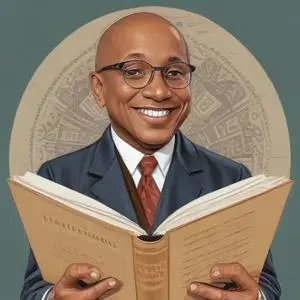
Founded Black History Month to promote awareness and education about African American history and culture, highlighting the contributions and achievements of Black people.
Carter G. Woodson was a pioneering American historian, author, journalist, and founder of the Association for the Study of African American Life and History (ASALH), who is widely regarded as the "Father of Black History." He is best known for establishing Negro History Week, which later evolved into Black History Month, and for being one of the first scholars to study the history of the African diaspora, including African American history.
Born on December 19, 1875, in New Canton, Virginia, Woodson was the son of former slaves Anne Eliza Riddle and James Henry Woodson. His mother, Anna, had been taught to read by her mistress, and Woodson's father, James, had helped Union soldiers during the Civil War after escaping from his owner. Despite the challenges he faced, Woodson was determined to pursue his education.
Woodson had to work in the coal mines of West Virginia to support his family, which delayed his formal education. However, he eventually graduated from Berea College and went on to earn graduate degrees from the University of Chicago. In 1912, Woodson became the second African American, after W.E.B. Du Bois, to obtain a Ph.D. degree from Harvard University. He is the only person whose parents were enslaved in the United States to achieve this feat.
Woodson's academic career was marked by his commitment to promoting African American history and culture. He taught at historically black colleges, including Howard University and West Virginia State University, and spent most of his career in Washington, D.C., managing the ASALH, public speaking, writing, and publishing.
One of Woodson's most significant contributions was the establishment of The Journal of Negro History in 1916, which provided a platform for scholars to share their research on African American history. He also wrote several books, including The Education of the Negro Prior to 1861 and A Century of Negro Migration, which are still considered essential reading for anyone interested in African American history.
In 1926, Woodson launched Negro History Week, which was initially celebrated during the second week of February to coincide with the birthdays of Frederick Douglass and Abraham Lincoln. The event was designed to promote the study of African American history and culture, and it quickly gained popularity across the United States.
Today, Negro History Week has evolved into Black History Month, which is celebrated throughout February. Woodson's pioneering work in promoting African American history has had a lasting impact on American education and culture.
Woodson believed that the study of African American history was essential for promoting racial pride and self-esteem among African Americans. He argued that the dominant narrative of American history was flawed because it excluded the contributions of African Americans, and he worked tirelessly to correct this oversight.
Woodson's philosophical contributions have had a profound impact on the development of Afrocentrism, a cultural and intellectual movement that seeks to recenter the study of history and culture around the experiences of African people.
Carter G. Woodson's legacy is immeasurable. He has inspired generations of scholars, historians, and activists to explore and celebrate African American history and culture. His work has also had a profound impact on American education, promoting diversity and inclusivity in the curriculum.
Today, Woodson's legacy continues to inspire new generations of leaders and scholars. His commitment to promoting African American history and culture has left an indelible mark on American society, and his work remains an essential part of our collective understanding of the African American experience.
_quotes:
"If a race has no history, it has no worthwhile tradition, it becomes a negligible factor in the thought of the world, and it stands in danger of being exterminated."
"Those who have no record of what their forebears have accomplished lose the inspiration which comes from the teaching of biography and history."
Woodson received numerous awards and honors for his work, including the Spingarn Medal, which he was awarded in 1926 for his outstanding contributions to African American history and culture.
In 1974, the U.S. Postal Service honored Woodson with a commemorative stamp, recognizing his pioneering work in promoting African American history.
Woodson passed away on April 3, 1950, but his legacy continues to inspire new generations of scholars, historians, and activists.
Born in 1868
A pioneering figure in the struggle for racial equality, advocating for civil rights and social justice through groundbreaking research and powerful writings.
Born in 1856
A pioneering figure in African-American education, he founded the Tuskegee Institute and advocated for racial uplift through self-improvement and economic empowerment. His autobiography, "Up from Slavery," remains a classic of American literature.
Born in 1902
A renowned poet, novelist, and playwright who powerfully voiced the experiences and struggles of African Americans during the Harlem Renaissance, using jazz and blues rhythms to convey the spirit of his people.
Born in 1891
A celebrated author and anthropologist who explored African-American culture through novels, stories, and folklore, particularly in the rural South during the early 20th century.
Born in 1908
A trailblazing lawyer and civil rights champion who broke racial barriers in the US justice system, serving as the first African American on the Supreme Court. He fought tirelessly for equality and justice, leaving a lasting impact on American history.
Born in 1913
Refused to give up her seat on a Montgomery, Alabama bus to a white person, sparking the Montgomery Bus Boycott, a pivotal event in the Civil Rights Movement.
97 Years Old
A prominent leader in the civil rights movement, advocating for racial equality and social justice through nonviolent means, leaving a lasting impact on American history.
Born in 1925
A prominent figure in the Civil Rights Movement, advocating for African American rights and self-defense, and a powerful orator who inspired a generation.
