


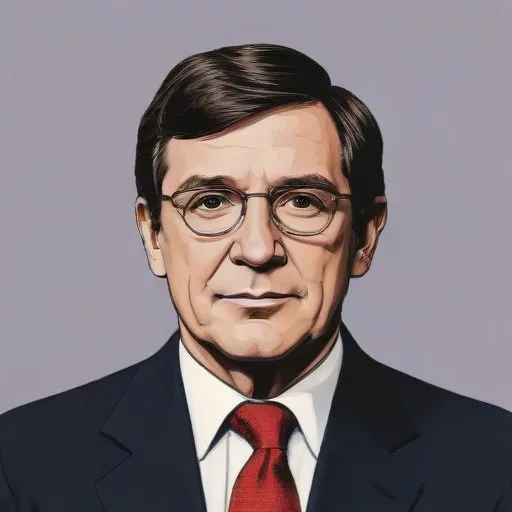
A prominent publisher and politician who served as Secretary of the Treasury, playing a key role in shaping the US banking system and Federal Reserve. He's most known for his work on the Glass-Steagall Act.
Carter Glass, a Virginia-born newspaper publisher and Democratic politician, left an indelible mark on the United States' financial regulatory system. As the primary architect of the Federal Reserve System and the Federal Deposit Insurance Corporation, Glass's contributions to the country's fiscal landscape are still felt today.
Born on January 4, 1858, in Lynchburg, Virginia, Glass began his career as a newspaper editor and publisher. His entry into politics came in 1899 when he won election to the Senate of Virginia, where he became a vocal advocate for segregationist policies. Glass's influence extended to the Virginia Constitutional Convention of 1902, where he played a significant role in shaping the state's disenfranchisement laws.
In 1902, Glass won election to the United States House of Representatives, eventually becoming Chairman of the House Committee on Banking and Currency in 1913. It was during this period that he collaborated with President Woodrow Wilson to pass the Federal Reserve Act, establishing a central banking system for the United States. Glass's expertise in financial matters led to his appointment as Secretary of the Treasury from 1918 to 1920.
In 1920, Glass accepted an appointment to represent Virginia in the United States Senate, a position he held until his death in 1946. During his tenure, he became Chairman of the Senate Appropriations Committee in 1933 and served as president pro tempore of the Senate from 1941 to 1945. Glass is perhaps best known for cosponsoring the 1933 Banking Act, also known as the Glass-Steagall Act, which created the Federal Deposit Insurance Corporation and enforced the separation of investment banking firms and commercial banks.
Glass's advocacy for segregationist policies and his role in shaping Virginia's disenfranchisement laws have been widely criticized by historians. However, his contributions to progressive fiscal and regulatory reform cannot be ignored. Glass's work on the Federal Reserve Act and the Glass-Steagall Act demonstrate his commitment to ensuring the stability of the U.S. financial system.
Carter Glass's impact on the U.S. financial regulatory system is still felt today. His work on the Federal Reserve System and the Federal Deposit Insurance Corporation helped shape the country's response to economic crises. While his legacy is complex and multifaceted, Glass remains an important figure in American financial history.
Despite his controversial past, Carter Glass's influence on the U.S. financial regulatory system is undeniable. His legacy serves as a reminder of the complex and often contradictory nature of American history.
Born in 1856
The 28th President of the United States, a Nobel Peace Prize winner, and a historian who played a key role in shaping international relations and global governance after World War I. He's most known for his idealistic vision of a League of Nations and his efforts to promote peace and diplomacy.
Born in 1882
Led the United States through the Great Depression and World War II, implementing a series of reforms known as the New Deal and helping to establish the country as a global superpower.
Born in 1874
The 31st President of the United States was a humanitarian and politician who led the country through the Great Depression and is known for his humanitarian efforts and infrastructure development. He's also infamous for his inability to mitigate the economic crisis.
Born in 1872
The 30th President of the United States, a lawyer and politician, led the country through a period of economic prosperity and limited government intervention, earning the nickname "Silent Cal" for his frugal and humble nature. He's most known for his minimalist approach to governance and tax cuts.
Born in 1855
A financier and diplomat who served as Secretary of the Treasury, known for shaping the country's economic policies and overseeing the Federal Reserve System. He also founded the National Gallery of Art.
Born in 1884
American captain, lawyer, and politician who served as the 50th United States Secretary of the Treasury, playing a key role in shaping the country's economic policies during the Great Depression. He's most known for his efforts to balance the federal budget and reduce government spending.
Born in 1868
The 32nd Vice President of the United States, serving from 1933 to 1941, is most known for being a strong supporter of states' rights and a vocal critic of President Franklin D. Roosevelt's New Deal policies. He later broke with Roosevelt and opposed the president's bid for an unprecedented third term.
Born in 1875
A financier and publisher who led the Federal Reserve and owned The Washington Post, known for shaping the US economy and media landscape.
