


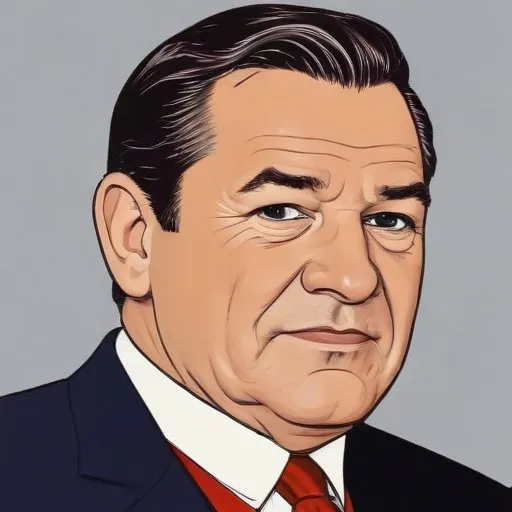
The 32nd Vice President of the United States, serving from 1933 to 1941, is most known for being a strong supporter of states' rights and a vocal critic of President Franklin D. Roosevelt's New Deal policies. He later broke with Roosevelt and opposed the president's bid for an unprecedented third term.
Known as "Cactus Jack," John Nance Garner was a prominent American Democratic politician and lawyer from Texas, who served as the 32nd Vice President of the United States under Franklin D. Roosevelt from 1933 to 1941. He was a stalwart figure in American politics, holding the unique distinction of serving as presiding officers of both chambers of the United States Congress as Speaker of the House and Vice President of the United States.
Born on November 22, 1868, in Red River County, Texas, Garner grew up in a rural area and developed a strong connection with the land and people. He studied law and was admitted to the bar in 1890. He began his political career as the county judge of Uvalde County, Texas, and later served in the Texas House of Representatives from 1898 to 1902.
Garner's rise to prominence began when he won election to represent Texas in the United States House of Representatives in 1902. He represented Texas's 15th congressional district from 1903 to 1933 and served as House Minority Leader from 1929 to 1931. In 1931, he became the Speaker of the House, a position he held until 1933.
In 1932, Garner sought the Democratic presidential nomination but eventually agreed to serve as Franklin D. Roosevelt's running mate. They won the election and were reelected in 1936. As Vice President, Garner played a crucial role in the passage of New Deal legislation, leveraging his wealth of political friendships and legislative skills to pilot Roosevelt's agenda through Congress. However, Garner, a conservative Southerner, eventually broke with Roosevelt over issues such as the centralization of power in the federal government and the sit-down strikes of labor unions.
Garner was known for his conservative views and believed in limited government intervention in economic matters. He was opposed to the New Deal's deficit spending and believed in the importance of states' rights. Despite his differences with Roosevelt, Garner remained committed to the Democratic Party and its ideals.
Garner married Mariette Rheiner in 1895, and they had one son, Tully Charles Garner. He was an avid outdoorsman and enjoyed hunting and fishing. Garner passed away on November 7, 1967, at the age of 98, leaving behind a legacy of public service and dedication to the American people.
John Nance Garner's legacy extends beyond his political achievements. He was a true statesman who worked tirelessly to serve his country and his people. His commitment to public service, his leadership skills, and his ability to build relationships across party lines have inspired generations of politicians and Americans alike.
John Nance Garner's remarkable life and career serve as a testament to the power of dedication, hard work, and public service. As a politician, leader, and American, he left an indelible mark on the nation's history, and his legacy continues to inspire and educate us today.
Born in 1882
Led the United States through the Great Depression and World War II, implementing a series of reforms known as the New Deal and helping to establish the country as a global superpower.
Born in 1884
The 33rd President of the United States, a strong leader who made tough decisions, including dropping atomic bombs on Japan and establishing the Marshall Plan to rebuild Europe after WWII.
Born in 1858
A pioneering leader who championed progressive reforms, trust-busting, and conservation, earning a Nobel Peace Prize for mediating the Russo-Japanese War. He's also famous for his rugged outdoorsmanship and "big stick" diplomacy.
Born in 1856
The 28th President of the United States, a Nobel Peace Prize winner, and a historian who played a key role in shaping international relations and global governance after World War I. He's most known for his idealistic vision of a League of Nations and his efforts to promote peace and diplomacy.
Born in 1865
The 29th President of the United States, a journalist-turned-politician, led the country through a period of post-war prosperity and scandalous corruption. He's infamous for his administration's numerous scandals and his own extramarital affairs.
Born in 1872
The 30th President of the United States, a lawyer and politician, led the country through a period of economic prosperity and limited government intervention, earning the nickname "Silent Cal" for his frugal and humble nature. He's most known for his minimalist approach to governance and tax cuts.
Born in 1874
The 31st President of the United States was a humanitarian and politician who led the country through the Great Depression and is known for his humanitarian efforts and infrastructure development. He's also infamous for his inability to mitigate the economic crisis.
Born in 1877
The 35th Vice President of the United States, a lawyer and politician who served under President Harry Truman from 1949 to 1953, known for his strong leadership and oratory skills. He played a crucial role in shaping the country's post-war foreign policy and domestic agenda.
