


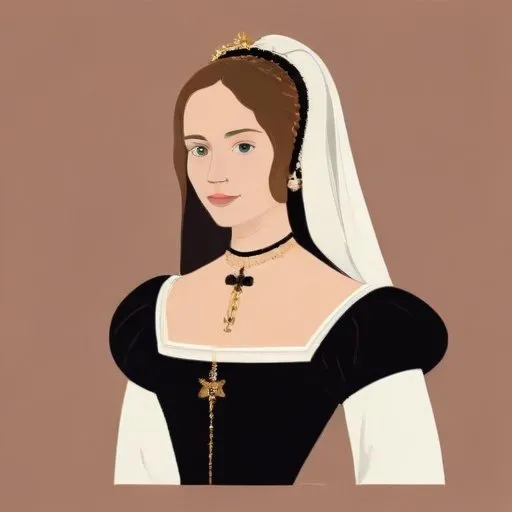
A 16th-century English noblewoman who married into the powerful Suffolk family and was known for her beauty, fashion sense, and scandalous love life. She was a trendsetter and a favorite of King Henry VIII.
Catherine Brandon, Duchess of Suffolk, is best known for her marriage to Charles Brandon, 1st Duke of Suffolk, and her subsequent rise to prominence as a prominent figure in the Tudor court. As the fourth wife of the powerful duke, Catherine navigated the treacherous waters of court politics, earning the respect and admiration of King Henry VIII and his courtiers alike.
Born circa 1519, Catherine Brandon was the daughter of the respected physician, Dr. Thomas Willoughby. Her family's standing and connections garnered her an advantageous marriage to Charles Brandon, who, as a close friend and advisor to King Henry VIII, held significant influence. The marriage not only elevated Catherine's social status but also introduced her to the intricate web of alliances, rivalries, and courtly politics that defined the Tudor era.
As Duchess of Suffolk, Catherine played a significant role in promoting the arts and education. She was a patron of the arts, fostering a love for music, literature, and dance at court. Her patronage extended to the sponsorship of prominent artists, writers, and musicians of the time, leaving an enduring legacy in the world of art and culture.
As a member of the Tudor court, Catherine was exposed to the intellectual and philosophical debates that characterized the Renaissance. Her own philosophical leanings were shaped by her Catholic upbringing and her marriage to Charles Brandon, a devout Catholic. Despite the tumultuous nature of the times, Catherine's beliefs remained steadfast, reflecting her commitment to her faith and her role as a dutiful wife and duchess.
Catherine's life was marked by both joy and tragedy. The birth of her two sons, Henry and Charles, brought her great happiness, but their early deaths left her bereaved. Her husband's later years were plagued by illness, and Catherine's devotion to him during this time earned her a reputation as a dedicated and caring wife.
Catherine Brandon, Duchess of Suffolk, left an indelible mark on the Tudor era and beyond. Her patronage of the arts, her diplomatic skills, and her steadfast commitment to her faith continue to inspire and captivate historians and scholars today. Her legacy serves as a testament to the power and resilience of women in a time when they were often relegated to the shadows.
Catherine Brandon, Duchess of Suffolk, occupies a unique position in the annals of Tudor history. Her marriage to Charles Brandon and her concomitant rise to prominence introduced her to the complexities of court politics, where she navigated the treacherous waters with elegance and aplomb. Her commitment to the arts, her faith, and her family has left an enduring legacy, one that continues to captivate and inspire us today.
As we gaze upon her portrait, created by the skilled hand of Hans Holbein, we are met with the penetrating gaze of a woman who has seen it all – a woman of strength, resilience, and unwavering devotion. In Catherine Brandon, Duchess of Suffolk, we are reminded of the power and agency of women in a bygone era, and the indelible mark they left on the course of history.
Born in 1457
First Tudor king of England, who ended the Wars of the Roses and established a strong, centralized government, bringing stability and prosperity to the country.
Born in 1485
Spanish princess who became the queen consort of England, playing a central role in the English Reformation and sparking the creation of the Church of England.
75 Years Old
A renowned actress, producer, and jewelry designer, best known for her iconic roles in film and television, including the Bond girl Solitaire and Dr. Quinn, Medicine Woman.
Born in 1926
The monarch of the United Kingdom and its Commonwealth realms, serving as a unifying figurehead and symbol of national identity, while also carrying out various ceremonial and charitable duties.
Born in 1489
Leader of the English Reformation, instrumental in creating the Church of England and authoring the Book of Common Prayer.
