


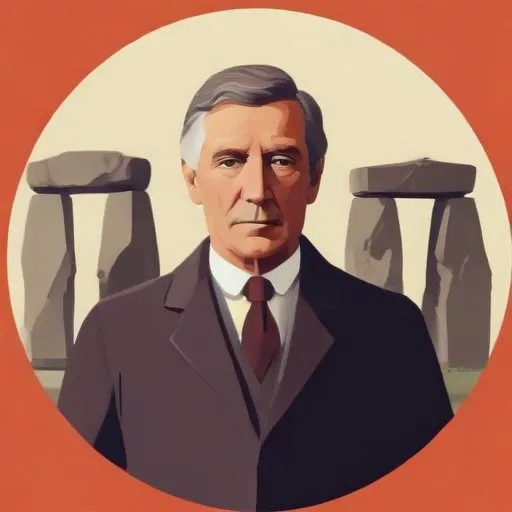
A barrister who purchased Stonehenge at an auction in 1915 and later gifted it to the British government, ensuring its preservation for the nation. He's a champion of cultural heritage!
Sir Cecil Herbert Edward Chubb, a British barrister and philanthropist, is best known for being the last private owner of Stonehenge, a prehistoric monument in Wiltshire, England. In 1918, he donated this ancient wonder to the British government, ensuring its preservation for future generations.
Born on April 14, 1876, in Shrewton, a village near Stonehenge, Chubb was the eldest son of Alfred and Mary Chubb. His father, Fred, was the village saddler and harness maker, a trade that had been passed down through generations. Chubb's early education took place at the local village school, followed by the Bishop Wordsworth's School in Salisbury, where he worked as a student teacher from the age of 14.
Chubb's academic prowess earned him a place at Christ's College, Cambridge, where he graduated with a double first in Science and Law, achieving Master of Arts and Bachelor of Law degrees.
Chubb's career as a barrister was marked by considerable success, amassing a substantial fortune. In 1902, he married Mary Bella Alice Finch, whose uncle, Dr. W. Corbin Finch, owned Fisherton House, a mental asylum. Following her uncle's death in 1905, the business and buildings were transferred to her, and Chubb became chairman of the hospital in 1924. Under his leadership, the hospital became the largest private mental hospital in Europe.
In addition to his professional pursuits, Chubb was an avid racehorse owner and breeder of Shorthorn cattle. He also served on Salisbury City Council and was a Justice of the Peace.
In 1915, Sir Cosmo Gordon Antrobus put Stonehenge up for auction, and Chubb, with his interest in the local area, attended the sale on a whim. He purchased Lot 15, which included Stonehenge, for £6,600, approximately £668,000 or $788,000 today.
Sir Cecil Chubb's donation of Stonehenge to the British government in 1918 has had a profound impact on modern society. This selfless act ensured the preservation of a national treasure, allowing future generations to marvel at this ancient wonder. Today, Stonehenge is one of the most visited tourist attractions in the world, attracting over 1 million visitors annually.
Chubb's contribution to the field of archaeology and cultural heritage is immeasurable. His legacy serves as a testament to the power of philanthropy and the importance of preserving our cultural heritage.
Sir Cecil Herbert Edward Chubb's remarkable life and achievements serve as a testament to the impact one person can have on the world. His selfless donation of Stonehenge has ensured that this ancient wonder will continue to inspire and fascinate people for generations to come.
Born in 1871
Prolific writer of historical novels and adventure stories, also a talented landscape painter.
Born in 1865
A renowned author and poet, best known for his imaginative and vivid stories, particularly "The Jungle Book", which have captivated readers of all ages with their timeless themes and memorable characters.
Born in 1859
Creator of the iconic detective Sherlock Holmes, known for his ingenious mysteries and clever plot twists.
Born in 1866
A visionary writer who pioneered the science fiction genre, crafting timeless classics like "The Time Machine" and "War of the Worlds" that continue to inspire and captivate audiences today.
Born in 1860
Creator of the beloved character Peter Pan, known for whimsical and imaginative storytelling that has captivated audiences for generations.
Born in 1879
This celebrated author crafted novels and plays that probed the human condition, exploring themes of social class, morality, and personal relationships, with a distinctive wit and insight. Their works continue to captivate audiences with their nuanced portrayals of English society during the early 20th century.
Born in 1885
A pioneering writer of the early 20th century, known for exploring themes of human nature, relationships, and the clash between individual desire and societal expectations through novels like "Sons and Lovers" and "Lady Chatterley's Lover".
Born in 1894
Author of dystopian classics like Brave New World, exploring the consequences of technological advancements on humanity. Known for prophetic warnings about government control and manipulation.
