


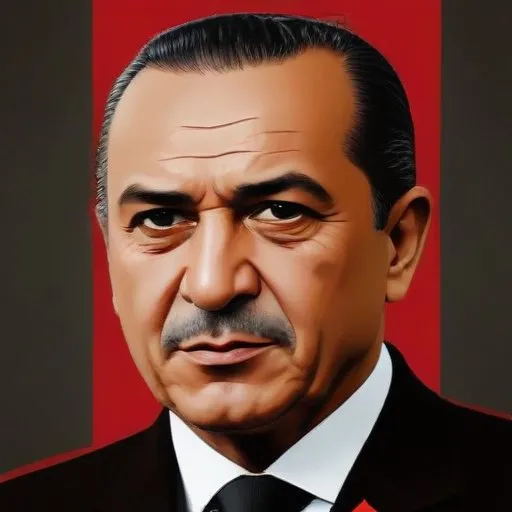
The third President of Turkey, serving from 1950 to 1960, known for his role in transitioning the country from a one-party to a multi-party system. He played a significant part in shaping Turkey's modern political landscape.
Cell Bayar, the third president of Turkey, is renowned for his instrumental role in transforming the country's economy and politics. As a pioneering figure, he founded Turkey's first bank, established its early financial institutions, and championed liberal economic policies, earning him a revered place in Turkish history.
Born on May 16, 1883, in Umurbey, a village in Bursa, Cell Bayar was the third son of Abdullah Fehmi Efendi, a religious leader and teacher who migrated from Lom, Ottoman Bulgaria. This humble beginning would shape Bayar's future, as he went on to play a significant role in shaping Turkey's destiny.
Bayar's career in politics began with the Committee of Union and Progress, where he established its Izmir and Bursa branches. Following the declaration of the Republic, he founded Turkey's early financial institutions, including the country's first bank, Bankas. Mustafa Kemal Atatürk, the founder of modern Turkey, appointed Bayar as prime minister in 1937 to liberalize the economy, a testament to Bayar's dedication to liberal economic policies.
After being overthrown and incarcerated following the 1960 coup d'état, Bayar continued to advocate for the restoration of rights of former politicians associated with the Democrat Party. Released from prison, he remained committed to democracy and human rights.
Cell Bayar passed away on August 22, 1986, at the age of 103, leaving behind a legacy as the longest-lived former head of state and a champion of Turkish democracy.
Bayar's contributions to Turkey's economic development, political liberalization, and democratization have had a lasting impact on modern Turkish society. His commitment to human rights, democracy, and economic growth continues to inspire future generations of Turkish leaders.
Bayar's advocacy for liberal economic policies and democratization reflects his deep-seated belief in individual freedom, human rights, and democratic values. His commitment to these principles has left an indelible mark on Turkey's political landscape.
"Democracy is not a gift, it is a right. And we must fight to protect it."
This quote, often attributed to Cell Bayar, encapsulates his unwavering dedication to democracy and human rights, inspiring generations to come.
Born in 1881
Founder of modern Turkey, leading the country's transition from the Ottoman Empire to a secular, democratic nation, and implementing sweeping reforms in education, law, and women's rights.
Born in 1884
Led Turkey's transition to a secular, democratic state, and played a key role in the country's modernization. He's remembered for his efforts to establish a strong, independent Turkey.
Born in 1924
A Turkish engineer-turned-politician who served as the country's 9th President, known for his efforts to modernize Turkey's economy and infrastructure. He played a key role in shaping Turkey's politics and economy during the latter half of the 20th century.
99 Years Old
A Turkish engineer and politician who served as the 8th President of Turkey, known for implementing economic reforms and liberalizing the country's economy. He's also credited with modernizing Turkey's infrastructure and industry.
Born in 1925
A Turkish journalist, scholar, and politician who served as the 16th Prime Minister of Turkey, known for his progressive policies and literary works. He played a significant role in shaping Turkey's modern politics and culture.
75 Years Old
The 11th President of Turkey, a politician and academic who played a key role in shaping Turkey's modern politics and foreign policy, known for his efforts to strengthen Turkey's ties with the EU.
