


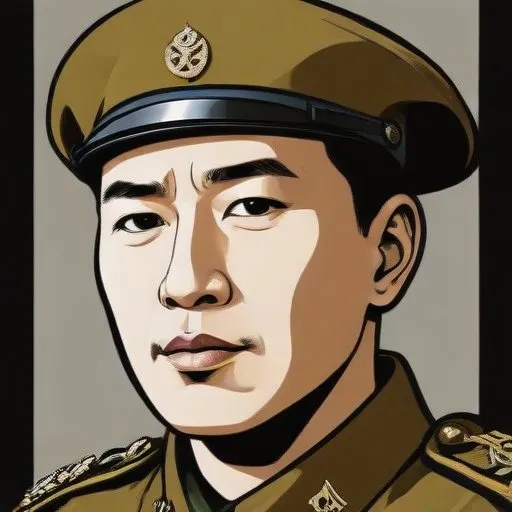
A South Korean general who played a crucial role in the country's independence movement against Japanese colonial rule, known for his bravery and strategic leadership.
Chae Myungshin is perhaps best known for his instrumental role in commanding South Korean military forces during the Vietnam War, as well as being the co-founder of the Korean Taekwondo Association. Through his military career and contributions to the sport of Taekwondo, Chae has left an indelible mark on Korean history and culture.
Chae was born on November 27, 1926, in Koksan County, to a father who was an anti-Japanese activist and a devout Christian mother. His early life was marked by hardship, with his father being imprisoned and later dying due to the aftereffects of torture in 1945. After his father's death, Chae's mother worked tirelessly to support their family.
Chae attended Pyongyang Normal School, graduating in 1945, and later became a teacher at Deokhae Elementary School in Yonggang, South Pyongan Province. However, following the Soviet occupation of the northern part of the Korean Peninsula, Chae was forced to flee to the southern part of the peninsula in 1947 to escape communism.
In 1948, Chae applied for the 5th cadet recruitment of the Chosun Defense Academy and passed, graduating as the top performer in his class. He was appointed as second lieutenant and quickly rose through the ranks, becoming a key figure in the South Korean military.
Chae's most notable military achievement came during the Vietnam War, where he commanded South Korean military forces, earning recognition for his bravery and strategic prowess. His leadership played a crucial role in the war effort, and his contributions are still celebrated today.
In addition to his military accomplishments, Chae is also revered as the co-founder of the Korean Taekwondo Association. His passion for the sport and his dedication to promoting it globally have made Taekwondo an integral part of Korean culture and identity.
Through his work in Taekwondo, Chae has inspired countless individuals, promoting the values of discipline, respect, and self-control. His legacy extends far beyond the realm of sports, with Taekwondo becoming a symbol of Korean pride and cultural heritage.
Throughout his life, Chae faced numerous challenges, from the loss of his father to the struggles of war. Despite these hardships, he remained steadfast in his commitment to his country and his people.
Chae passed away on November 25, 2013, leaving behind a legacy that continues to inspire generations of Koreans and martial arts enthusiasts around the world.
Chae Myungshin's contributions to Korean history and culture are immeasurable. Through his military service and his work in Taekwondo, he has left an indelible mark on the country and its people.
As a military leader, Chae's bravery and strategic prowess have become the stuff of legend, while his role in promoting Taekwondo has turned the sport into a global phenomenon. His legacy serves as a testament to the power of dedication, hard work, and passion.
95 Years Old
A South Korean general and politician who served as the 5th President of South Korea, known for his military coup and subsequent authoritarian rule. He's infamous for his role in the Gwangju Democratization Movement's brutal suppression.
93 Years Old
South Korea's first democratically elected president, known for his role in the country's transition to democracy and his key role in the 1988 Seoul Olympics. He's also infamous for his involvement in a military coup and human rights abuses.
Born in 1924
A South Korean politician and Nobel laureate who served as the country's 8th president, known for his Sunshine Policy towards North Korea and efforts to promote democracy and human rights. He is a symbol of South Korea's transition from dictatorship to democracy.
98 Years Old
The 7th President of South Korea, a key figure in the country's democratization, known for his efforts to reform the government and economy. He's also remembered for his "New Economy" plan and anti-corruption initiatives.
84 Years Old
South Korea's first businessman president, known for his economic reforms and infrastructure projects, particularly the Four Major Rivers Project. He was also involved in a corruption scandal that led to his imprisonment.
Born in 1897
A key figure in South Korea's transition to democracy, he served as president from 1960 to 1962 and advocated for human rights and social justice. He's remembered for his efforts to rebuild the country after the Korean War.
