


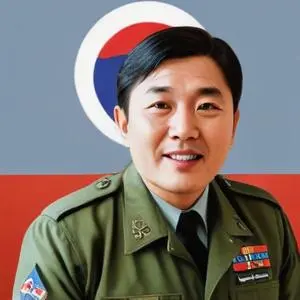
A South Korean politician and Nobel laureate who served as the country's 8th president, known for his Sunshine Policy towards North Korea and efforts to promote democracy and human rights. He is a symbol of South Korea's transition from dictatorship to democracy.
Kim Daejung, the eighth president of South Korea, is revered as a beacon of democracy and human rights in East Asia. He is renowned for his unwavering commitment to promoting peace and reconciliation with North Korea, earning him the esteemed Nobel Peace Prize in 2000.
Born on January 6, 1924, in Haui-do, South Jeolla Province, Kim Daejung was the second of seven children to a farming family. His early life was marked by adversity, with his family struggling to make ends meet under Japanese colonial rule. This experience instilled in him a deep sense of social justice, which would later drive his political career.
Kim's entry into politics began in the 1960s, when he joined the New Democratic Party as a member of the opposition. He was an outspoken critic of military dictatorship, advocating for democracy and human rights. Despite facing numerous challenges, including imprisonment and exile, Kim persevered, running unsuccessfully in presidential elections in 1971, 1987, and 1992.
In 1998, Kim Daejung made history by becoming the first opposition candidate to win the presidency. His inauguration marked a significant shift in South Korea's approach to North Korea, as he pursued a policy of détente, dubbed the "Sunshine Policy." This bold initiative culminated in the first-ever inter-Korean summit in June 2000, where Kim met with North Korean leader Kim Jong-il.
In recognition of his tireless efforts to promote democracy and human rights in South Korea and East Asia, Kim Daejung was awarded the Nobel Peace Prize in 2000. This prestigious honor solidified his reputation as a champion of peace and reconciliation, earning him comparisons to Nelson Mandela, the former President of South Africa.
Kim Daejung's legacy extends far beyond his presidential term, which ended in 2003. His commitment to democracy, human rights, and peace has inspired generations of Koreans and people around the world. His Sunshine Policy continues to shape South Korea's approach to North Korea, and his Nobel Peace Prize serves as a testament to the power of courageous leadership.
"I will not be intimidated. I will not be defeated. I will not be silenced."
"The Sunshine Policy is not a policy of unilateral concession, but a policy of mutual benefit and coexistence."
Kim Daejung's life and legacy are inextricably linked with South Korea's struggle for democracy and human rights. His unwavering commitment to these principles has left an indelible mark on the country's political landscape, inspiring future generations to strive for peace, reconciliation, and social justice.
80 Years Old
A South Korean soldier-turned-politician who served as the country's 9th President, known for his progressive reforms and efforts to reduce corruption. He's also remembered for his tragic death by suicide in 2009.
95 Years Old
A South Korean general and politician who served as the 5th President of South Korea, known for his military coup and subsequent authoritarian rule. He's infamous for his role in the Gwangju Democratization Movement's brutal suppression.
93 Years Old
South Korea's first democratically elected president, known for his role in the country's transition to democracy and his key role in the 1988 Seoul Olympics. He's also infamous for his involvement in a military coup and human rights abuses.
84 Years Old
South Korea's first businessman president, known for his economic reforms and infrastructure projects, particularly the Four Major Rivers Project. He was also involved in a corruption scandal that led to his imprisonment.
98 Years Old
The 7th President of South Korea, a key figure in the country's democratization, known for his efforts to reform the government and economy. He's also remembered for his "New Economy" plan and anti-corruption initiatives.
82 Years Old
The 8th Secretary-General of the United Nations, a South Korean politician and diplomat who played a crucial role in promoting global peace, security, and sustainable development. He's known for his efforts to combat climate change and advocate for human rights.
