


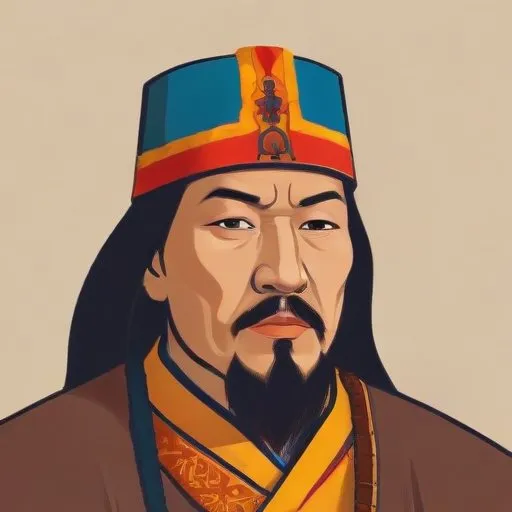
A Mongol khan who ruled over the Chagatai Khanate, a vast empire in Central Asia, and is known for his military campaigns and administrative reforms. He played a significant role in shaping the region's politics and culture.
As the second son of the legendary Genghis Khan, Chagatai Khan is renowned for his crucial role in upholding the Yassa, the written code of law that governed the Mongol Empire. His unwavering commitment to his father's vision earned him the responsibility of overseeing the execution of the Yassa, cementing his place as a key figure in Mongolian history.
Little is known about Chagatai's early life, but it is well-documented that he was considered hot-headed and temperamental by his relatives. This trait was particularly evident in his refusal to accept Jochi, his brother, as a full brother. Chagatai's strong stance on this issue often led to conflicts with his family members.
In 1206, Genghis Khan appointed Chagatai to command 4 mingghans (military units) and granted him an appanage around the Altai Mountains. Chagatai joined his father and brothers in the invasion of the Jin Empire in 1211, capturing several cities and playing a crucial role in the Mongol conquest of Shaanxi and Henan.
Chagatai's military prowess was further demonstrated in the campaign against the Khwarazmian Empire, where he, along with his father and brothers, captured Otrar in 1218, Samarkand in 1220, and Urgench in 1221. Although the Urgench campaign was marked by tension between Chagatai and Jochi, he was eventually tasked with maintaining communication between Mongol forces and building bridges and restoring roads.
The siege of Bamiyan in 1221 was a personal tragedy for Chagatai, as his son Mutukan was killed during the battle. This event had a profound impact on Chagatai, who was deeply affected by the loss of his child.
Chagatai was present at the Battle of the Indus River, where Jalal ad-Din Mingburnu was defeated. He later commanded the rear guard during the Mongol conquest of the region.
Chagatai's dedication to his father's legacy and the Yassa code of law has had a lasting impact on Mongolian history. His role in maintaining order and stability in the Mongol Empire paved the way for the empire's expansion and growth.
In contrast to his brothers, Chagatai's military campaigns were often characterized by a more cautious and strategic approach. While his brothers were known for their brutal tactics, Chagatai's focus on maintaining communication and building infrastructure demonstrates a more nuanced understanding of warfare.
Chagatai Khan's life and legacy are inseparable from the rise and fall of the Mongol Empire. His commitment to the Yassa code of law and his role in maintaining order in the empire have cemented his place as one of the most important figures in Mongolian history.
Through his military campaigns, personal relationships, and leadership, Chagatai Khan has left an indelible mark on the Mongol Empire and the world at large. His story serves as a testament to the power of loyalty, duty, and the enduring legacy of the Mongol Empire.
Born in 1186
The second Great Khan of the Mongol Empire, who expanded the empire's territories through military campaigns and established trade routes, is most known for his military conquests and administrative skills. He played a crucial role in shaping the Mongol Empire's governance and economy.
Born in 1209
The Mongolian emperor who expanded the Mongol Empire, conquering vast territories and establishing a vast network of trade routes, while also promoting religious tolerance and meritocracy.
Born in 1215
Founded the Yuan dynasty in China, extending the Mongol Empire's reach and establishing trade routes, cultural exchange, and administrative systems that shaped the region's development.
