


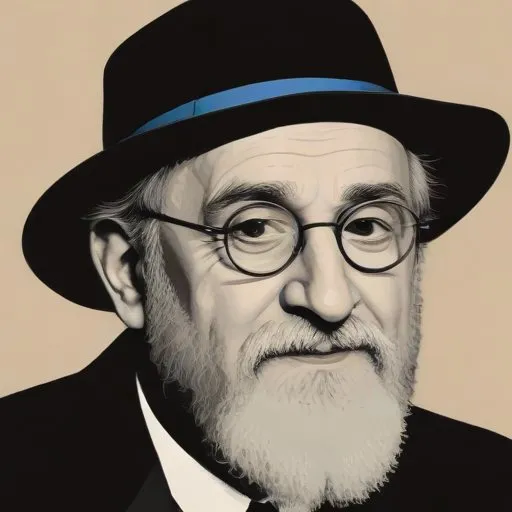
A rabbi and author who explored the intersection of Judaism and modernity through novels like "The Chosen" and "My Name is Asher Lev", delving into themes of identity, faith, and cultural heritage.
Chaim Potok is renowned for his poignant novels that delve into the complexities of Jewish identity, faith, and culture. His debut novel, The Chosen, catapulted him to fame, spending 39 weeks on The New York Times bestseller list and selling over 3.4 million copies worldwide.
Born Herman Harold Potok on February 17, 1929, in Brooklyn, New York, to Jewish immigrants from Poland, Chaim was the oldest of four children, all of whom either became or married rabbis. He received an Orthodox Jewish education and was ordained as a Conservative rabbi after graduating from the Jewish Theological Seminary of America.
His love for literature was ignited at the tender age of 16, when he read Evelyn Waugh's Brideshead Revisited. This sparked a passion that would eventually lead him to become a writer. At 17, he made his first submission to The Atlantic Monthly, receiving a note of encouragement from the editor.
In 1955, Potok enlisted with the U.S. Army as a chaplain, serving in South Korea from 1955 to 1957. This experience had a profound impact on him, challenging his beliefs and broadening his perspective. He later credited this period with shaping his writing and worldview.
Potok's writing career spanned over three decades, during which he authored more than a dozen novels. Some of his notable works include:
Potok received numerous awards and accolades for his contributions to literature, including:
Chaim Potok's work has left an indelible mark on modern Jewish literature. His novels have been translated into numerous languages and continue to resonate with readers worldwide. His legacy extends beyond his writing, inspiring generations of writers, scholars, and thinkers to explore the complexities of faith, identity, and culture.
Potok's words offer a glimpse into his thoughts on writing, faith, and identity:
Chaim Potok passed away on July 23, 2002, but his literary legacy continues to inspire and captivate audiences, ensuring his place as one of the most beloved and respected authors of the 20th century.
98 Years Old
A Romanian-American writer, professor, and humanitarian who survived the Holocaust and dedicated his life to promoting peace, justice, and human rights, leaving a lasting impact on literature and activism.
Born in 1903
A Polish-American writer who crafted poignant, introspective stories that explored the human condition, often drawing from his Jewish heritage and experiences. His works are celebrated for their nuanced characters and philosophical depth.
Born in 1859
A renowned Yiddish author and playwright, best known for creating Tevye the Dairyman, a beloved character later adapted into the iconic musical "Fiddler on the Roof".
Born in 1907
A prominent Jewish scholar who merged traditional faith with modern philosophy, advocating for social justice and interfaith dialogue through his influential writings and activism.
Born in 1903
A prominent Talmudic scholar and philosopher who merged traditional Jewish thought with modern Western philosophy, creating a unique synthesis of faith and reason.
Born in 1881
Founded Reconstructionist Judaism, a movement that views Judaism as a evolving civilization, emphasizing community and cultural heritage over traditional theology. He's known for redefining Judaism in a modern, inclusive, and adaptive way.
Born in 1878
A philosopher who explored the nature of human relationships, dialogue, and existence, and is best known for his concept of "I-Thou" relationships, which emphasizes mutual respect and understanding.
Born in 1906
A Lithuanian-French philosopher who developed the concept of "ethics as first philosophy," emphasizing the importance of responsibility towards others and the face-to-face encounter. His work has influenced contemporary thought on morality, justice, and human rights.
