


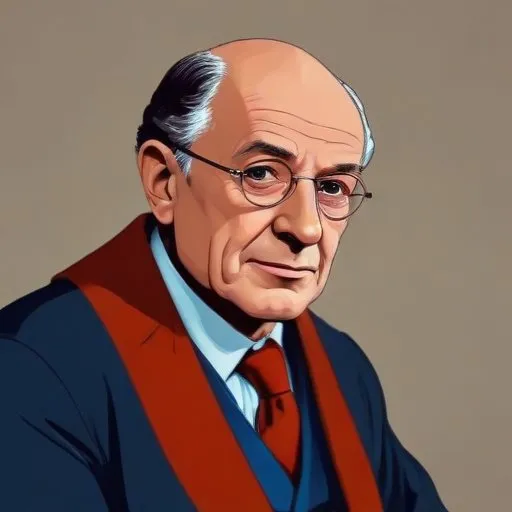
A French Marxian economist and historian who analyzed the Soviet Union's economic development and its deviations from Marxist principles, and wrote extensively on the history of India.
Charles Bettelheim was a distinguished French economist and historian who left an indelible mark on the world of Marxism, economic development, and decolonization. As the founder of the Center for the Study of Modes of Industrialization (CEMI) at the EHESS, he advised governments of several developing countries, shaping their economic trajectories during the turbulent period of decolonization.
Bettelheim was born on November 20, 1913, in Paris, France, to Henri Bettelheim, a Viennese Austrian of Jewish origin, and a French mother. His family was forced to flee France after the outbreak of World War I, eventually settling in Switzerland and then Egypt.
After completing his studies in philosophy, sociology, law, and psychology, Bettelheim joined the Young Communists and subsequently the French Communist Party. His proficiency in Russian led him to Moscow in 1936, where he worked as a tourist guide, journalist, and film director. However, his experiences during the Soviet purges and trials of Bolshevik leaders who opposed Joseph Stalin made him maintain a critical distance from the Soviet Union, without abandoning his Communist convictions.
In the 1960s, Bettelheim founded the Center for the Study of Modes of Industrialization (CEMI) at the EHESS, which became a hub for Marxist thought and economic research. He advised governments of several developing countries, including Cuba, Algeria, and Vietnam, helping them navigate the complexities of decolonization and economic development.
Bettelheim's work focused on the analysis of capitalist and socialist economies, critiquing the concept of "development" and arguing that it was a myth perpetrated by imperialist powers. He believed that true economic development could only be achieved through a revolutionary transformation of society.
Charles Bettelheim's influence extended far beyond France, with his work shaping the intellectual landscape of countries like Spain, Italy, Latin America, and India. He was considered one of the most visible Marxists in the capitalist world, earning recognition from publications like Le Monde.
Bettelheim's legacy continues to inspire generations of scholars, economists, and thinkers. His contributions to Marxist thought, economic development, and decolonization remain vital to understanding the complexities of globalization and the struggles of developing nations.
In 1937, Bettelheim married a young militant, and the couple remained committed to the causes of socialism and anti-imperialism throughout their lives.
Bettelheim's critiques of Soviet socialism and his divergent views on Marxist theory led to controversies and criticisms from some quarters. He was excluded from the Communist Party for his "slanderous remarks" and faced opposition from those who saw him as a deviationist.
Bettelheim received numerous awards and honors for his contributions to economics, history, and Marxism, including the Prix de l'Académie des sciences morales et politiques in 1967.
Charles Bettelheim passed away on July 20, 2006, leaving behind a rich legacy of intellectual contributions, critiques, and controversies that continue to shape our understanding of the world.
Born in 1910
Founded the Monthly Review, a influential socialist magazine, and wrote extensively on Marxist economics, criticizing capitalism and advocating for socialism.
Born in 1923
A Marxist economist and Trotskyist activist who developed theories on long-wave economic cycles and imperialism, influencing socialist thought and activism.
Born in 1905
Existentialist philosopher and playwright who argued that humans have complete freedom to choose their actions and create their own meaning in life, influencing modern thought on morality and individual responsibility.
Born in 1908
A pioneering feminist philosopher who wrote extensively on ethics, politics, and gender, famously arguing that "one is not born, but rather becomes, a woman."
Born in 1918
A prominent 20th-century philosopher who developed the concept of "ideological state apparatuses" and reinterpreted Marxism, influencing modern social and political thought.
