


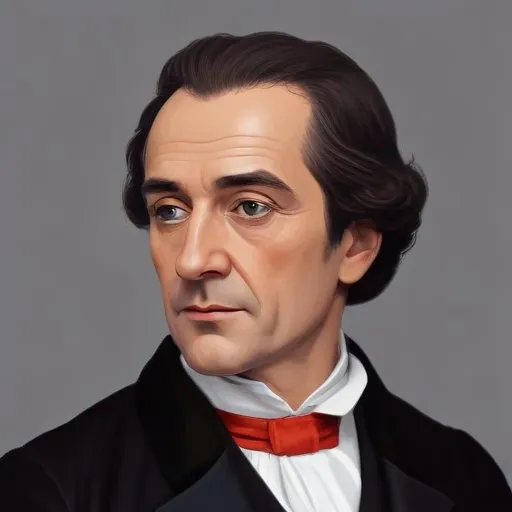
A 17th-century French writer and composer, known for his witty and satirical works, including plays, poems, and songs, that showcased his clever wordplay and humorous storytelling.
Known for his unique blend of music and poetry, Charles Coypeau dAssoucy was a renowned French musician and burlesque poet of the 17th century. With a career spanning over four decades, dAssoucy entertained the French court, wrote poems for the royal family, and even performed at the court of Charles I in England.
Born on October 16, 1605, in Paris, France, Charles Coypeau began running away from home at a young age. His father, in an attempt to discipline him, placed him in the Jesuit College of Clermont, where he acquired a solid education in classics and Christian doctrine.
Despite his formal education, dAssoucy's real passion lay in music and poetry. He would often sneak away to watch puppeteers and organ grinders on the Pont-Neuf, which had a significant impact on the formation of his musical and poetic talents.
By the time he was 17, dAssoucy had left Paris and begun his long life of wandering. He eeked out a livelihood by composing, singing for local elites, and teaching the lute. His travels took him to Italy, where he mastered the Italian theorbo, an instrument still rare in France.
In the early 1630s, dAssoucy met Pierre de Nyert, a gifted singer, in Grenoble. He then traveled to England, where he performed at the court of Charles I, and later to the Low Countries, where he played and sang for the exiled Marguerite de Lorraine, duchess of Orléans.
By 1636, dAssoucy had returned to Paris and had begun using the nom de plume "dAssoucy." He was soon entertaining the French court and writing poems for the royal family. His talent and wit earned him a position as a musician in ordinary to the King (musicien ordinaire du Roi).
For over a decade, dAssoucy participated in numerous court concerts, solidifying his reputation as a master musician and burlesque poet. His connections with the LHuilliers, a wealthy financier family, also led to his involvement with a group of free spirits, libertins, around the philosopher Pierre Gassendi.
Charles Coypeau dAssoucy's unique blend of music and poetry left a lasting impact on the French court and the literary world. His burlesque poetry, infused with humor and wit, paved the way for future generations of poets and writers.
Today, dAssoucy is remembered as a true original, a master of his craft who brought joy and laughter to the French court and beyond. His legacy serves as a testament to the power of music and poetry to bring people together and transcend time.
Born in 1622
A 17th-century master of comedy, he penned witty plays that satirized the French aristocracy, leaving a lasting impact on Western theater. His works remain widely performed and adapted today.
Born in 1639
A 17th-century master of French tragedy, crafting intricate, psychologically complex dramas that probed the human condition, influencing the development of Western theatre.
Born in 1606
A 17th-century French mastermind behind iconic plays like "Le Cid" and "Horace", known for pioneering the classical French tragedy genre.
Born in 1694
A witty and insightful 18th-century writer and philosopher who used satire to critique societal norms and advocate for reason, tolerance, and human rights.
Born in 1712
A pioneering thinker who shaped modern democracy and education with his ideas on social contracts, general will, and the importance of early childhood education. His writings influenced the French Revolution and modern political thought.
Born in 1749
Developed nebular hypothesis of the origin of the solar system and formulated Laplace's equation, a fundamental concept in mathematics and physics. He's considered the founder of celestial mechanics.
