


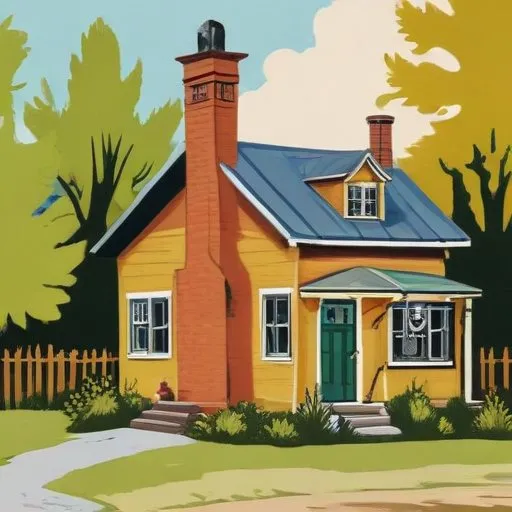
A visionary American painter who captured the essence of the natural world through vibrant, expressive watercolors, often blending realism with fantasy.
Charles E. Burchfield is renowned for his evocative watercolors of nature scenes and townscapes, capturing the essence of the American landscape with unprecedented sensitivity. With a career spanning over five decades, his works have been exhibited in over 109 museums across the United States, cementing his status as one of the most celebrated American painters of the 20th century.
Born on April 9, 1893, in Ashtabula, Ohio, Burchfield was raised by his widowed mother in Salem, Ohio. His early life was marked by a deep connection with nature, which would later become the hallmark of his artistic style. He drew inspiration from American writers like Thoreau and Willa Cather, as well as Finnish writers who described nature with remarkable vividness.
Burchfield's artistic journey began at the Cleveland Institute of Art, where he graduated in 1916. During his time at the institute, he was profoundly influenced by his teacher, Henry Keller, a prominent figure in the Cleveland School of watercolor painting. This influence would shape Burchfield's unique style, characterized by bold brushstrokes and an emphasis on capturing the emotional essence of the American landscape.
In 1921, Burchfield moved to Buffalo, New York, where he worked as a designer at the H.M. Birge wallpaper company. However, it was his decision to dedicate himself to painting full-time in 1928 that marked a turning point in his career. With the help of artist-gallerist Frank Rehn, Burchfield's work began to gain recognition, and he went on to create some of his most iconic pieces.
Burchfield's oeuvre is characterized by its diversity and emotional depth. Some of his most notable works include "The Insect Chorus" (1917), "The Song of the TelePhone" (1917), and "Churchyard" (1947). His paintings are now part of the permanent collections of prominent institutions like the Metropolitan Museum of Art, the Whitney Museum of American Art, and the Museum of Modern Art, among others.
Burchfield's artistic philosophy was deeply rooted in his connection with nature. He believed that art should evoke emotions and convey the essence of the natural world. His paintings often featured abstract, expressive brushstrokes, which he used to capture the dynamic energy of the American landscape.
Burchfield's contributions to American art have been immense. His innovative approach to watercolor painting has inspired generations of artists, and his emphasis on capturing the emotional essence of the natural world has helped shape the nation's artistic identity.
"I have always tried to paint the drama, the excitement, the joy, the sorrow of the natural world."
Burchfield's life and work spanned a period of significant social and cultural change in America. His paintings not only reflect the beauty of the natural world but also provide a window into the hopes, fears, and aspirations of the American people during the 20th century.
Today, the Burchfield Penney Art Center in Buffalo, New York, is dedicated to preserving his legacy and showcasing his remarkable body of work.
Born in 1882
A pioneering realist artist capturing the essence of modern American life through poignant, cinematic scenes of urban isolation and melancholy, evoking a sense of nostalgia and quiet contemplation.
Born in 1887
Pioneering American modernist artist famous for bold, colorful depictions of enlarged flowers, landscapes, and abstract compositions that explored new ways of representing the American Southwest. Her innovative style and independence inspired generations of artists.
Born in 1924
Designed iconic buildings in Birmingham, including the Central Library, blending modernist and brutalist styles. His work transformed the city's landscape and continues to inspire architects today.
Born in 1877
A pioneering figure in American Modernism, creating vibrant, symbolic paintings that explored the relationship between nature and human experience. Known for his bold, expressive works that blended abstraction and representation.
Born in 1880
Pioneering abstract artist and educator who explored expressive forms and colors, creating a unique American modernist style. Known for his innovative and emotive works that bridged representation and abstraction.
Born in 1892
A pioneering American modernist, blending cubism and abstract expressionism to create vibrant, jazz-inspired paintings that explored the intersection of art and everyday life.
Born in 1889
A renowned Regionalist painter and educator, known for his vibrant, detailed depictions of everyday American life and his influential teaching style.
Born in 1891
Creator of iconic American Regionalist paintings, including the enigmatic "American Gothic," which has become a cultural symbol of rural America.
